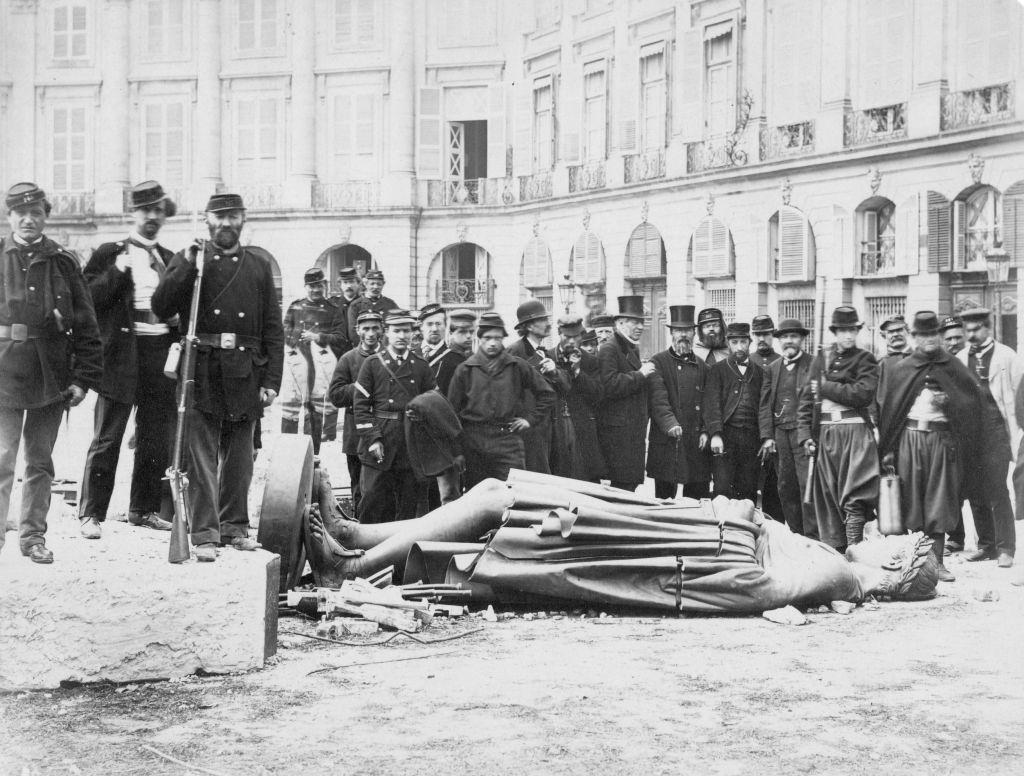
Stretched across the ground, the fallen figure of Napoleon I lies amid dust and broken masonry, its laurel-crowned head turned toward a tight ring of onlookers. Uniformed men with rifles stand nearest, while civilians in dark coats and brimmed hats gather behind them, their faces fixed on the toppled bronze as if taking stock of a suddenly altered world. The grand façades in the background—rows of shuttered windows and arched doorways—frame the scene like a stage set for political drama.
Up on the Colonne Vendôme, the emperor once stood as a symbol of military glory and imperial power; down here, he becomes an object lesson in how quickly public monuments can be rewritten by upheaval. The photograph’s stillness heightens the tension: there is no motion left, only the evidence of a decisive act and the calm-after-the-storm posture of those who witnessed it. In the context of civil conflict, removing a statue is never just about metal and stone—it is about memory, legitimacy, and who gets to define the nation’s story.
Few historical images communicate the stakes of urban revolution as clearly as this moment from 1871, when politics spilled into the streets and the built landscape became contested ground. The overthrow of the Napoleon statue atop the Vendôme Column speaks to the era’s fierce arguments over empire, republic, and the meaning of past wars. For readers interested in Paris history, the Paris Commune, and the politics of monuments, this photograph offers a stark, SEO-friendly window into how symbols fall when authority fractures.