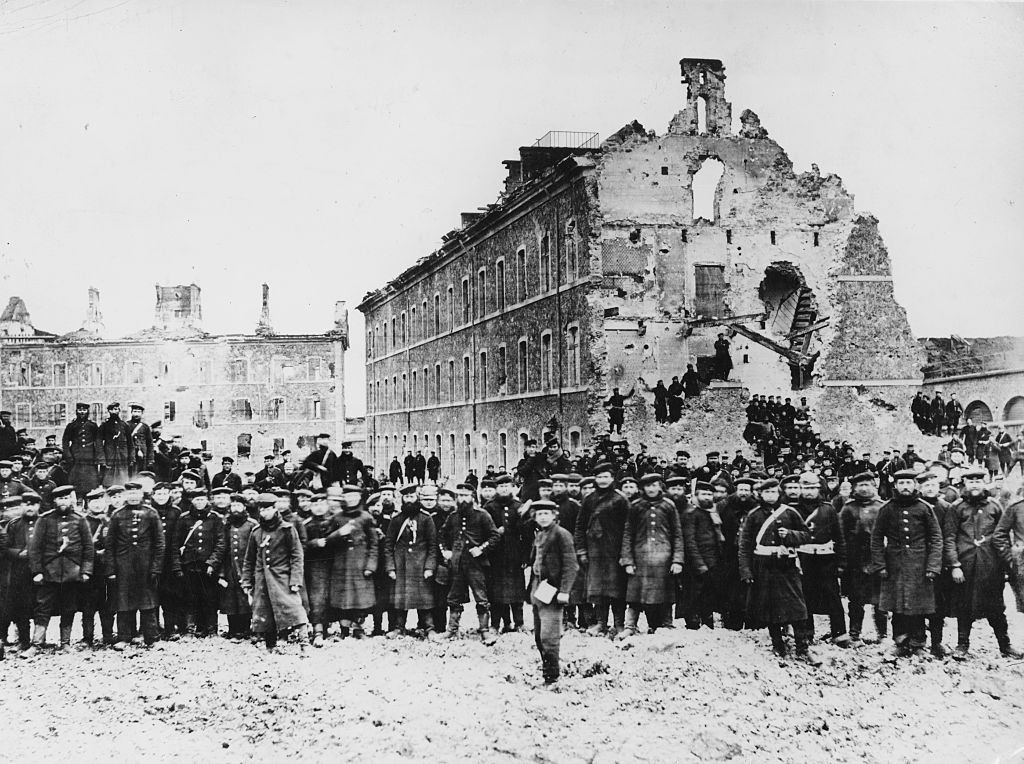
Against a skyline torn open by artillery, Prussian troops gather inside the shattered works of Fort Issy near Versailles during the siege of Paris, on 1 February 1871. The long barrack-like building still holds its lines, while the adjacent wall is ripped into a jagged shell, its windows blasted into irregular holes. In the foreground, ranks of uniformed soldiers crowd the muddy ground, their dark coats and caps forming a dense band against the pale rubble.
What stands out is the strange calm of the moment: men pose and look toward the camera as others climb over broken masonry, turning a battlefield into a temporary stage. The fort’s stone and brick surfaces show the pockmarks of bombardment, and the gaping interior of the ruined section hints at rooms exposed to winter air and fire. Even without motion, the photograph conveys the scale of the siege—how modern firepower could unmake a strongpoint built to defend the approaches to Paris.
Seen today, this Franco-Prussian War scene is more than a record of military occupation; it’s a stark study in what a “victory” can look like when measured in collapsed walls and exhausted faces. Fort Issy’s ruins offer context for the wider story of 1870–1871, when Paris endured encirclement, shelling, and upheaval that would echo long after the guns fell silent. For readers exploring the siege of Paris, Prussian troops at Fort Issy, and the physical legacy of nineteenth-century warfare, this image provides an unvarnished window into the aftermath.