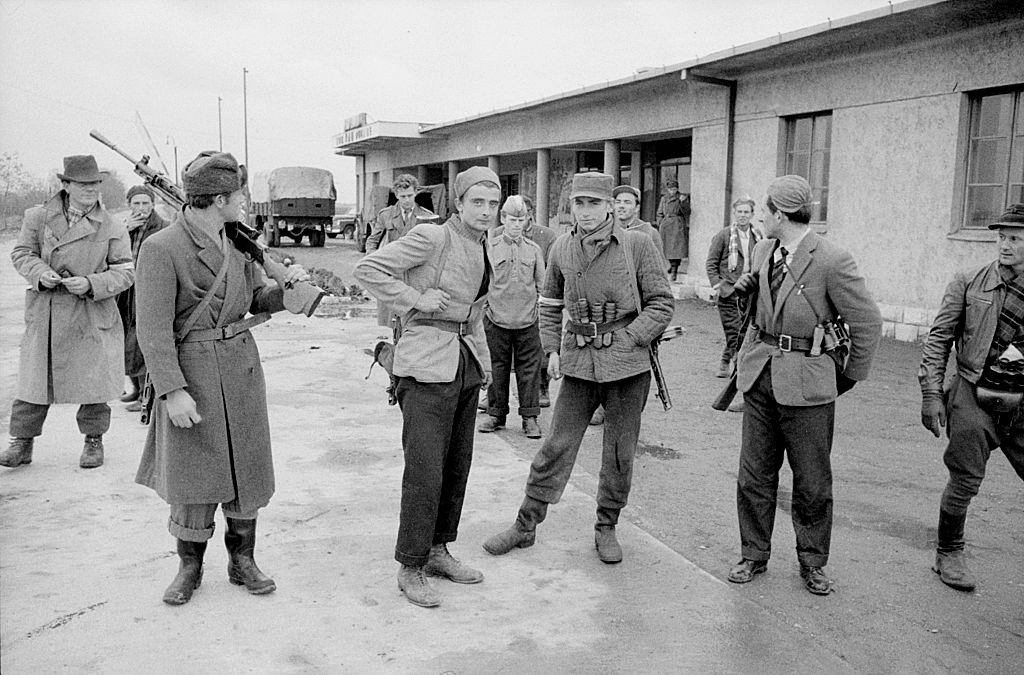
At a stark border post between Austria and Hungary, a small cluster of armed men stands in the open yard, half-posed and half-alert, as if the moment could tilt from conversation to crisis without warning. Rifles and bandoliers hang against workmanlike coats, and the plain, utilitarian building behind them frames the scene with an almost bureaucratic calm. Trucks and bystanders linger in the background, hinting at movement, supply, and uncertainty—an improvised checkpoint in the middle of a political storm.
The title places this scene within the Hungarian uprising against the Soviet regime, and the details match the tense logic of revolution: control the crossing, control the flow of people, news, and weapons. Some faces look toward the camera, others to the side, suggesting arguments, instructions, or simply the restless scanning that comes with guarding a frontier. It’s the kind of border moment where ideology becomes practical—who gets through, who gets turned back, and how authority is performed when old systems are breaking apart.
For readers exploring Cold War history, civil wars, and the Hungarian Revolution, this photo offers a grounded view of how large events were lived on the edge of nations. The frontier here isn’t a line on a map; it is a place of decisions made in real time, with ordinary infrastructure repurposed for extraordinary circumstances. Seen today, the image invites reflection on the fragile mechanics of sovereignty and the human improvisation that fills the gaps when a regime’s power falters.