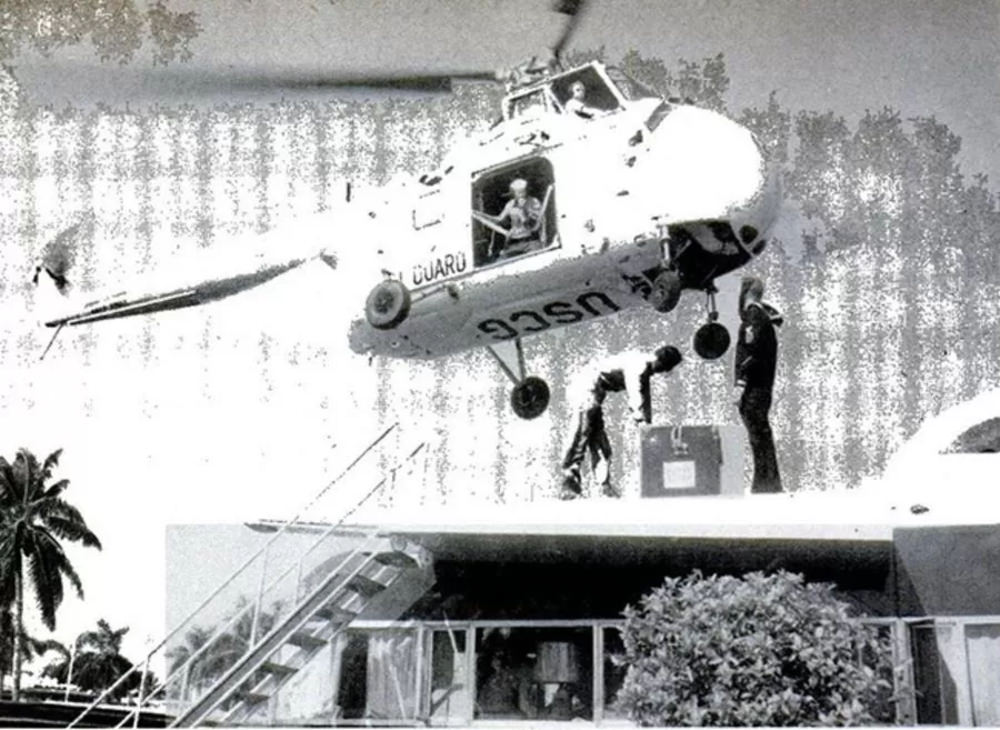
Mid-century optimism practically hums in the scene as a helicopter hovers just above a flat rooftop, its landing gear dangling while ground crew reach up with the practiced urgency of a delivery. The aircraft’s open doorway hints at a cramped cabin repurposed for businesslike movement, and the whole moment feels like a demonstration staged to prove that modern life could be streamlined, airborne, and on-demand. With palms and low-slung architecture in the background, the photo leans into the era’s faith in engineering to erase distance.
The post title points to a 1952 “Executive Flagship” concept—part home, part office, and entirely a product of the invention-minded 1950s—when companies sold the public on mobile living as the next logical step after suburban comfort. Even if the image and headline don’t spell out every specification, they evoke the same promise: a single vehicle that could carry you, your work, and your amenities as effortlessly as a briefcase. It’s the ancestor of today’s RV luxury builds and “work from anywhere” culture, filtered through an age that imagined the near future arriving with rotors, chrome, and clever compartments.
What makes this historical photo so compelling is its blend of spectacle and practicality, the kind of promotional realism that made experimental transportation feel inevitable. The rooftop exchange suggests executive convenience—quick access, minimal friction, and the impression that an entire day’s schedule could be lifted above traffic and terrain. For readers interested in vintage inventions, retro mobility, and the roots of modern executive travel, this image offers a vivid window into how the 1950s marketed technology as lifestyle—one vehicle, one platform, and a whole world made smaller by design.