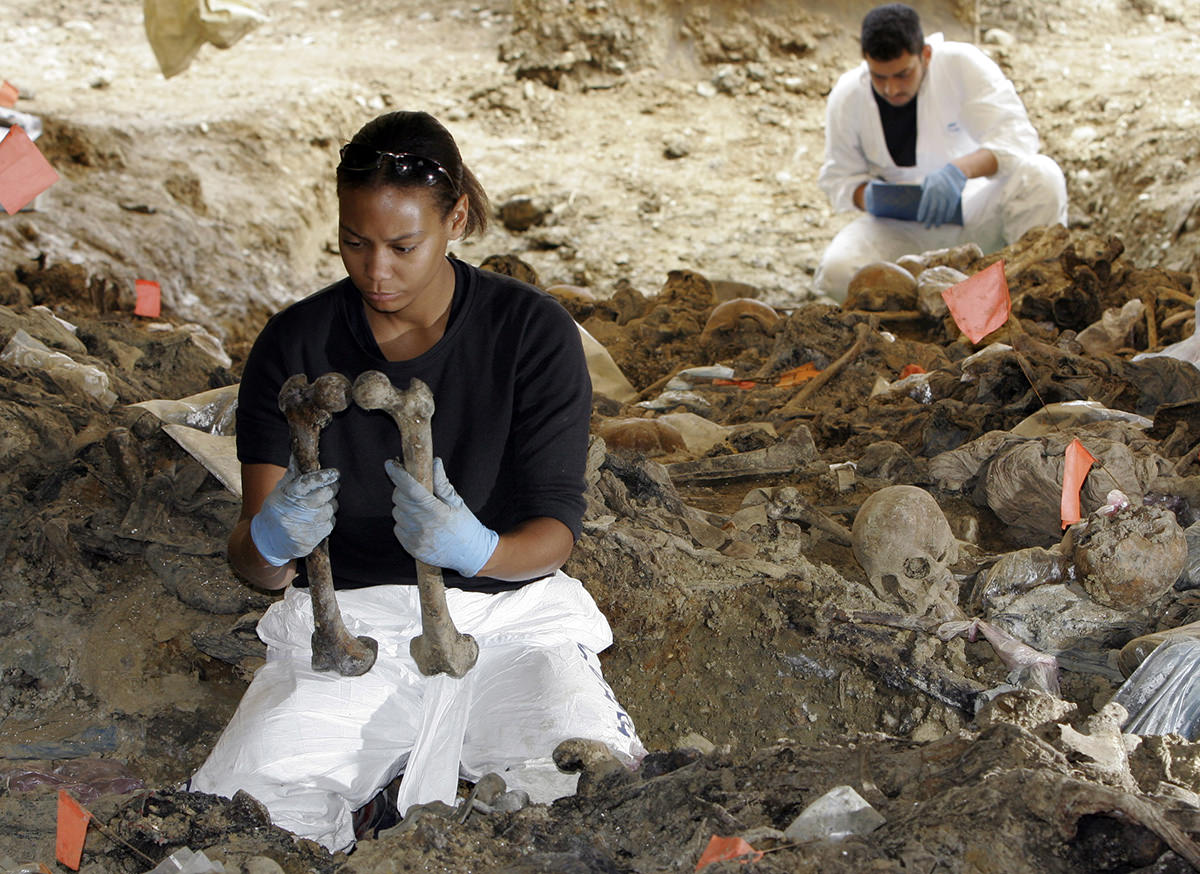
At the edge of an open excavation in Kamenica, forensic expert Sharna Daley of London sits front left, gloved and intent, weighing two long bones in her hands as if they were the last pieces of a difficult puzzle. The ground around her is crowded with disturbed earth, scattered remains, and the muted markers of a controlled dig, where every fragment must be seen, logged, and handled with care. In the background, another investigator in protective clothing works quietly among the same debris, reinforcing the sense that this is painstaking science carried out in the shadow of violence.
What draws the eye is the contrast between method and horror: careful posture, clinical gloves, and a steady gaze set against a field of bones and broken belongings. Daley’s task—determining whether the two bones belong to the same person—speaks to the central challenge of mass grave exhumation, where commingled remains can erase identities unless reconstructed through expert analysis. The photo’s composition keeps the viewer close to that moment of judgement, where anatomy and evidence must align before any larger story can be told.
Civil wars leave behind not only ruined landscapes but also unanswered questions, and forensic work like this becomes a form of historical record-making. Each identification attempt bridges the gap between anonymous loss and documented truth, supporting investigations, accountability, and the possibility of burial with dignity. For readers searching for images of forensic anthropology, mass grave excavation, and post-conflict recovery in Kamenica, this scene offers an unflinching look at how history is retrieved from the ground—bone by bone.