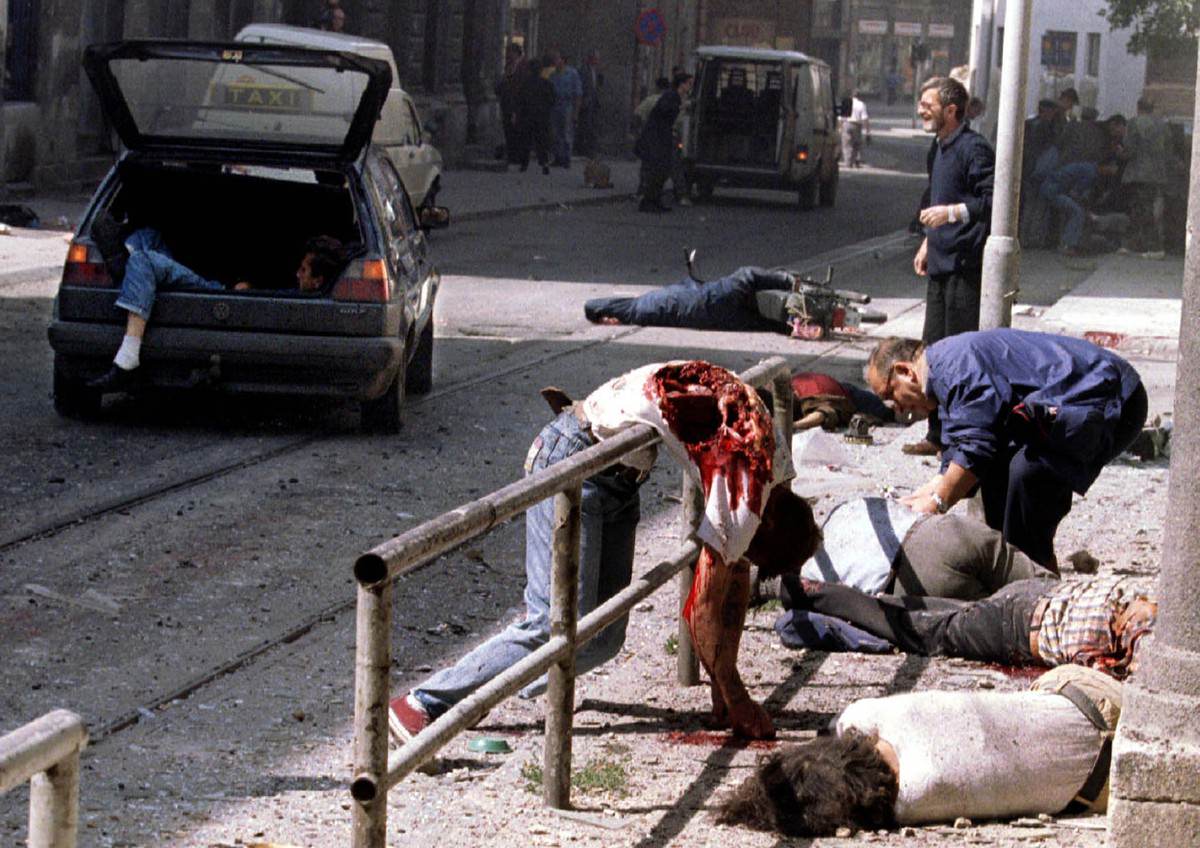
Chaos spills across an ordinary Sarajevo street as a mortar blast turns the entrance to an indoor market into a scene of mass casualty. Bodies lie on the pavement and curb, some motionless, while survivors crouch low and look around in disbelief. A car sits with its rear hatch open, a stark reminder of how quickly everyday errands can become desperate attempts to flee or find shelter.
In the foreground, the violence is visceral: blood streaks clothing and concrete, and scattered debris hints at the force of the explosion. A man bends over the wounded near the sidewalk railing, trying to help amid confusion and danger, while others hover in the background beside a small van. The street’s hard lines—rails, curb stones, storefront shadows—frame the human cost of urban warfare in a way no statistic can soften.
Dated August 28, 1995, the photograph anchors the broader story of the Bosnian War and the siege that battered Sarajevo for years, where markets and queues were perilous targets. It is also an unflinching record of civil war’s cruelty: civilian spaces transformed into killing grounds, and bystanders forced into the roles of rescuers, witnesses, and mourners all at once. For readers searching the history of Sarajevo’s market attacks and the realities of life under shelling, this image remains a grim but essential document.