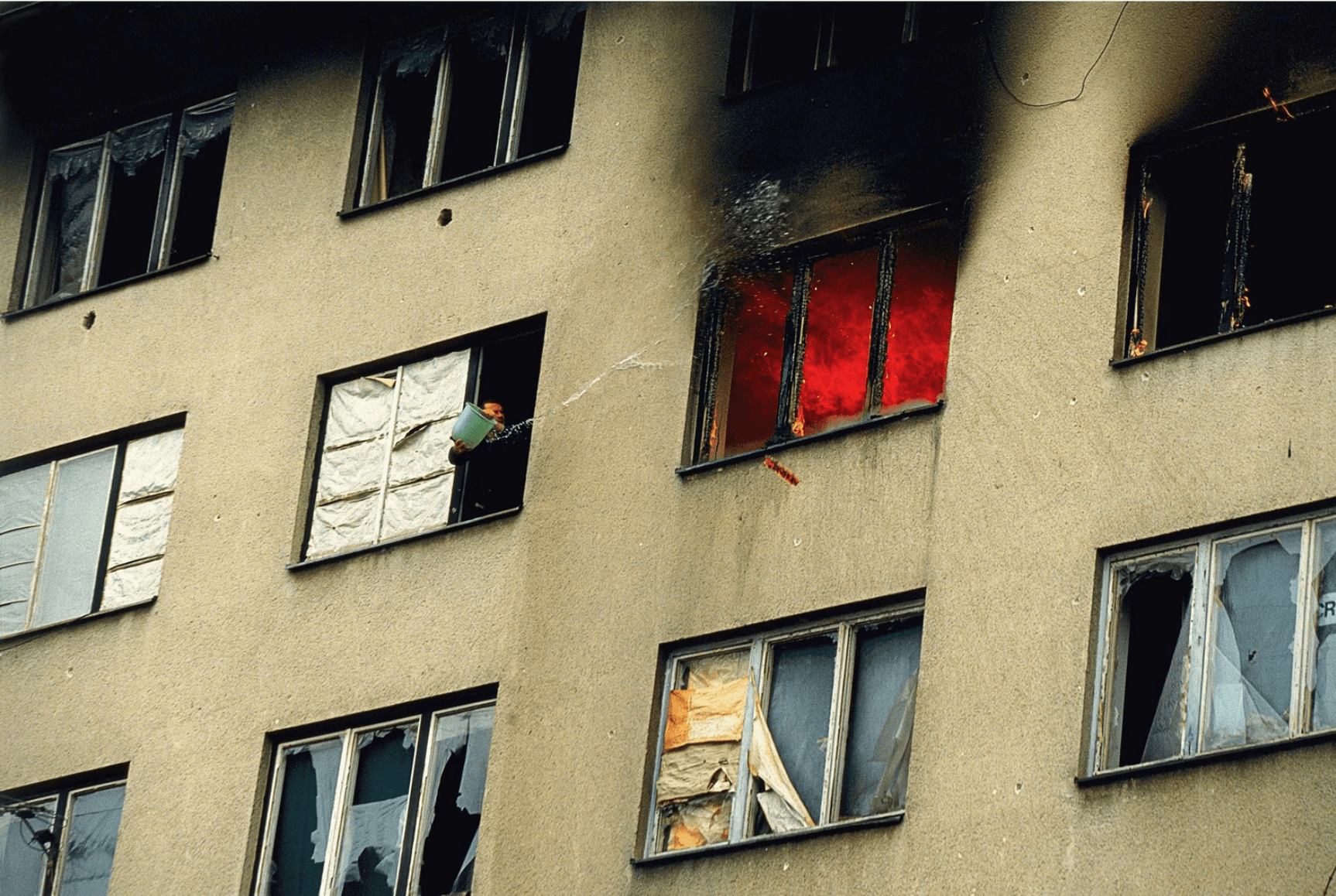
Against the blank concrete of a Sarajevo apartment block, a man leans out of a shattered window with a small container in hand, trying to douse flames roaring from a neighboring flat. The firelight turns the interior a fierce red, while smoke stains the façade above the frames. Torn curtains and broken glass speak of a building already worn down by violence before the blaze even takes hold.
The title anchors the scene in Grbavica, Bosnia, in 1996—an uneasy aftermath when civil war had not yet loosened its grip on everyday life. Arson here reads not as an accident but as a weapon, and the man’s improvised response underlines how ordinary residents were often left to confront catastrophe with whatever they could find. In a single moment, the photograph holds both the brutality of deliberate destruction and the stubborn reflex to save what can be saved.
Details across the windows—boards, paper coverings, empty frames—add texture to a story of displacement, contested neighborhoods, and homes turned into targets. For readers searching for Bosnia War history, Sarajevo 1996, or Grbavica arson, the image offers a stark, immediate reference: a civilian caught between the politics of identity and the basic human impulse to protect shelter. It is a reminder that the end of a conflict on paper can still leave streets—and lives—smoldering.