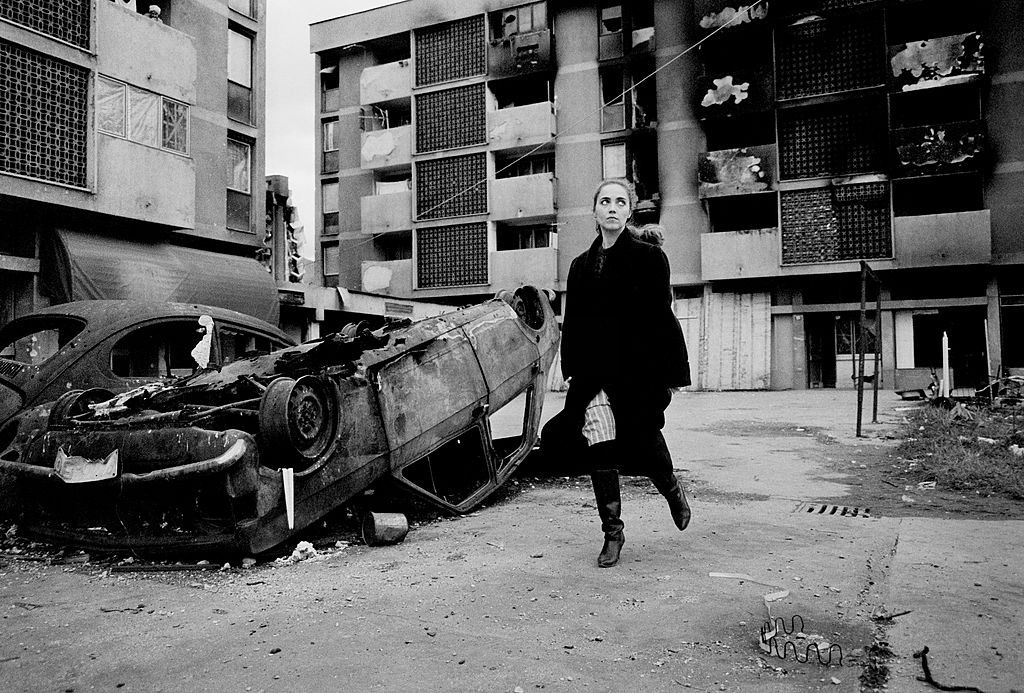
Across the broken paving of Hero’s Square, a young girl sprints past an overturned car, her body angled forward as if speed itself might offer protection. Behind her, the facades of apartment blocks loom with dark, punched-out windows and scarred concrete, the everyday architecture of home transformed into a jagged backdrop of war. The title anchors the moment to Sarajevo’s siege in 1994, when moving through open ground could mean crossing an invisible line of danger.
Nothing in the frame feels staged; it reads like a reflex caught mid-stride, with debris scattered underfoot and wreckage left where it fell. The abandoned vehicle, flipped on its side, becomes both barricade and warning sign, a mute reminder of shelling and the sudden violence that could visit a street without notice. In this kind of urban frontline, civilians learned routes, timing, and quick dashes—small tactics for survival in a city under constant threat.
For readers seeking historical context on the Bosnian War and the Sarajevo frontline, the photograph offers a stark, human-scale entry point into what “siege” meant in daily life. It’s a scene about movement and vulnerability as much as destruction: a child’s run set against ruins that used to be ordinary. The image lingers because it compresses the broader story of civil wars into a single, urgent passage through public space.