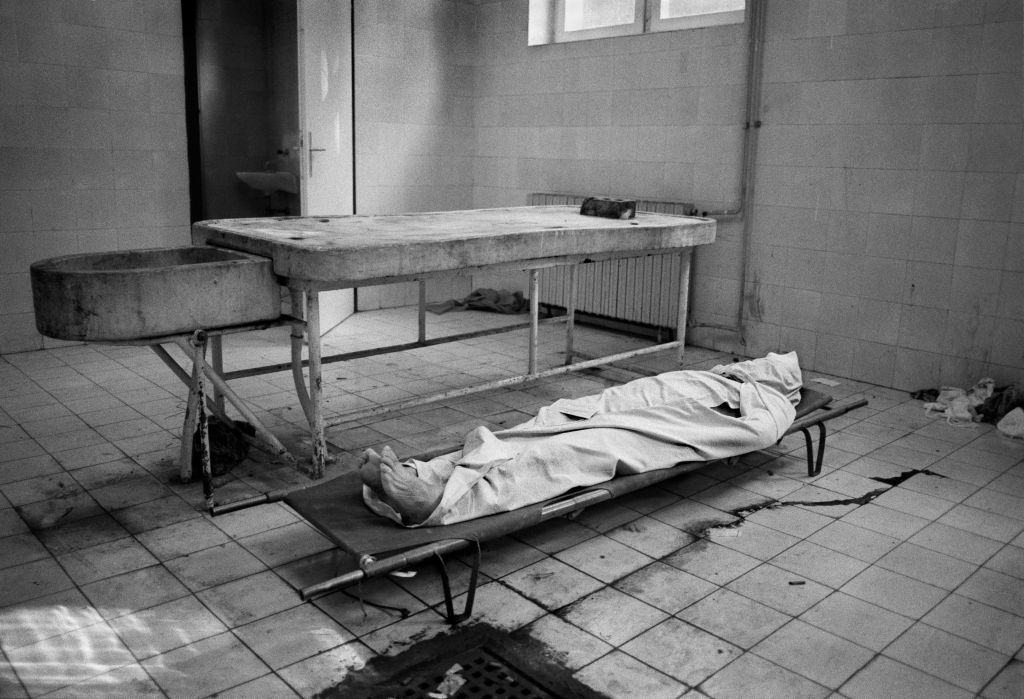
Under harsh fluorescent light, a tiled morgue room in besieged Sarajevo becomes a stark record of war’s daily toll. A body lies on a low stretcher, wrapped in a sheet, while a metal examination table and deep basin sit nearby, their surfaces worn and stained. The open doorway and bare radiator hint at an institution still trying to function in a city cut off, where even the most basic civic services were strained by months of violence.
The siege of Sarajevo, stretching across four years and still ongoing in 1994, turned ordinary spaces into front lines of survival and loss. Morgues and hospitals faced shortages, overcrowding, and the relentless arrival of casualties, making death not an abstract statistic but a constant presence. In the silence of this room—no crowds, no ceremony—grief feels procedural, compressed into the cold routines of identification and waiting.
For readers exploring civil wars and the Bosnian conflict, this photograph offers an unflinching perspective on the human cost behind headlines about shelling, snipers, and blockades. The composition emphasizes absence: the missing family members, the disrupted rituals, the lives reduced to a sheet on a frame. It’s a difficult image, yet an essential one for understanding how prolonged siege warfare reshapes a city, its institutions, and the intimate geography of mourning.