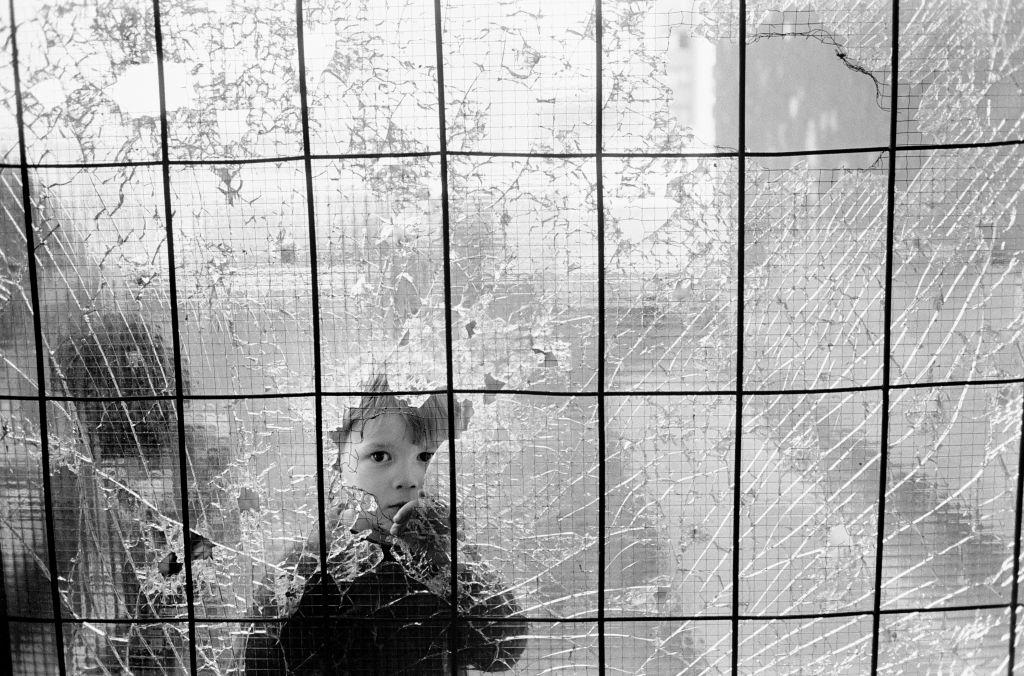
A child’s face appears in the small, jagged opening of a shattered pane, framed by a grid of metal bars and a spiderweb of cracks. The broken glass reads like a map of violence—pocked, splintered, and uneven—yet the boy’s steady gaze pulls the viewer away from the damage and toward the human cost behind it. Set in Dobrinja, a suburb of Sarajevo, the scene evokes the claustrophobia of life lived indoors, where even a window becomes both lookout and shield.
Behind the fractured surface, everyday domestic space feels abruptly militarized, as if the boundary between home and street has been rewritten by gunfire. The bullet-riddled window suggests not one moment of impact but repeated danger, an accumulation that turns architecture into testimony. In the broader history of civil wars and urban sieges, such details matter: they show how conflict is endured not only on front lines, but in stairwells, kitchens, and children’s rooms.
Sarajevo’s wartime memory is often told through sweeping narratives of strategy and politics, yet photographs like this insist on a quieter truth—the endurance of families and the altered childhoods that follow. The boy’s expression, partially obscured by broken glass, speaks to vigilance learned too early and curiosity constrained by fear. For readers searching for the history of the Siege of Sarajevo, Dobrinja, or the civilian experience of the Bosnian War, this image offers a stark, intimate entry point into what “civil wars” leave behind.