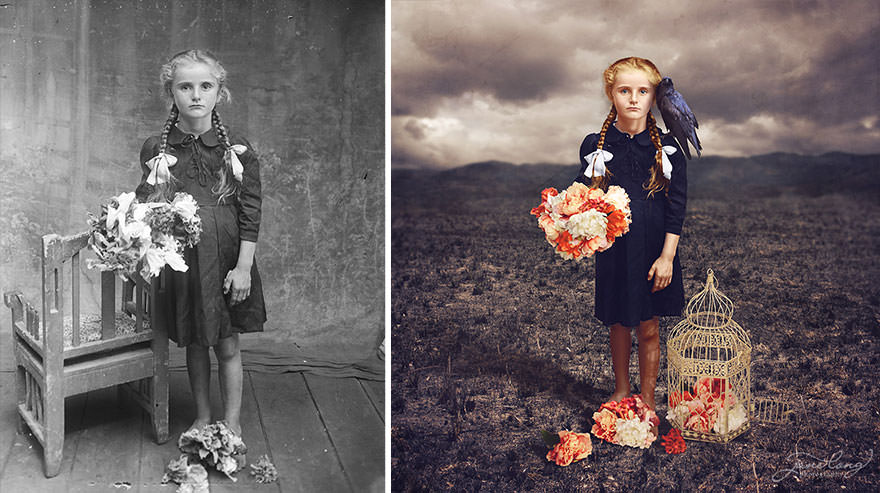
A solemn young girl stands with braided hair and a steady, unblinking gaze, clutching a bouquet that feels almost too large for her small hands. In the original glass-plate portrait, the studio setting is spare—wooden floorboards, a simple chair, and the soft falloff of light that turns fabric and skin into gradients of gray. Those quiet details, typical of early photographic practice, invite close looking: the careful pose, the formal dress, and the sense that the sitter is being asked to hold still not only for the camera, but for memory itself.
Colori’s recolor work shifts the scene from straightforward documentation into something more conceptual and theatrical. Deep navy clothing, vivid flowers, and a brooding sky recast the child’s stillness as a kind of narrative, heightened by the unexpected presence of a dark bird perched at her shoulder. The tonal decisions lean into emotion rather than strict realism, using colorization as interpretation—an artistic imagination layered onto historical texture.
Seen side by side, the monochrome source and the modern reimagining reveal why historic photo colorization continues to fascinate collectors, photographers, and social-history readers. The glass-plate photograph preserves the era’s visual language—controlled, formal, and materially fragile—while the recolored version asks what else the image can be when freed from the limits of early emulsions. It’s a reminder that restoring old photos isn’t only about adding color; it can also be a way of reopening the past, letting a silent portrait speak in new tones.