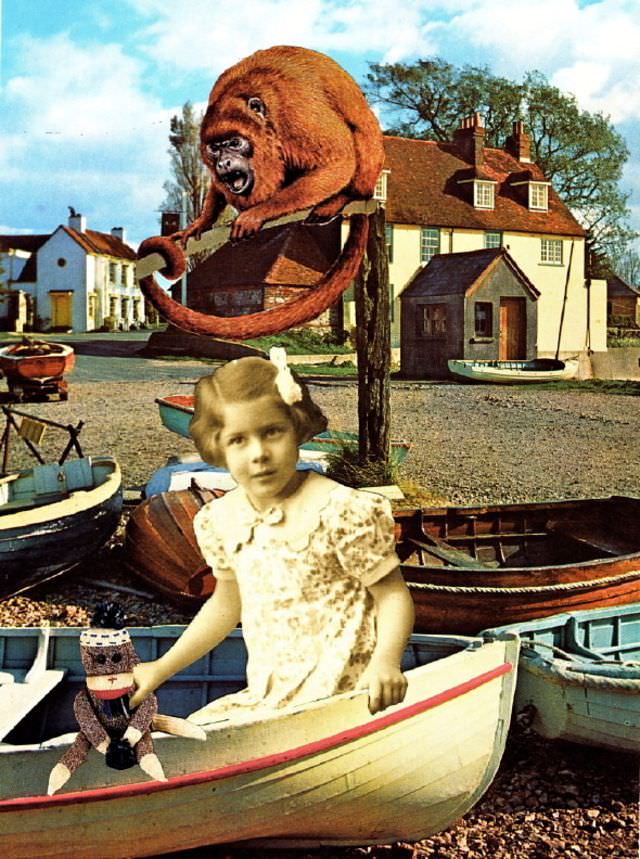
Jenny sits in the bow of a small boat with a knitted toy clasped in her hand, her neat dress and hair bow giving the scene a quiet, posed innocence. Around her, the harbor is crowded with dinghies and working boats pulled up on the pebbled shore, their paint worn by salt and use. Behind the boats, low houses with pitched roofs and chimneys suggest a settled waterfront community, the kind of place where daily life turns with the tide.
Over the rooftops, a fantastically oversized howler monkey clings to a post, its long tail curling like a banner across the middle ground. The scale is clearly impossible, and that impossibility is the point: this looks like a playful piece of early photomontage or hand-tinted postcard art, where humor and spectacle mattered as much as realism. The monkey’s open mouth and sharp gaze amplify the title’s sense of mischief, turning a child’s “favorite toy” into a prop in a larger visual joke.
At the heart of the image is the tension between documentary detail and imaginative intervention—real boats, real buildings, and a child’s steady stare set against a surreal animal that belongs to storybook exaggeration. For readers interested in Chichester Harbor imagery, seaside history, or vintage British postcard-style artwork, the composition offers plenty to linger over: textures of timber and rope, the geometry of rooftops, and the era’s fondness for whimsical edits. It’s an invitation to think about how people once used photographs not only to preserve a place, but also to reinvent it for entertainment.