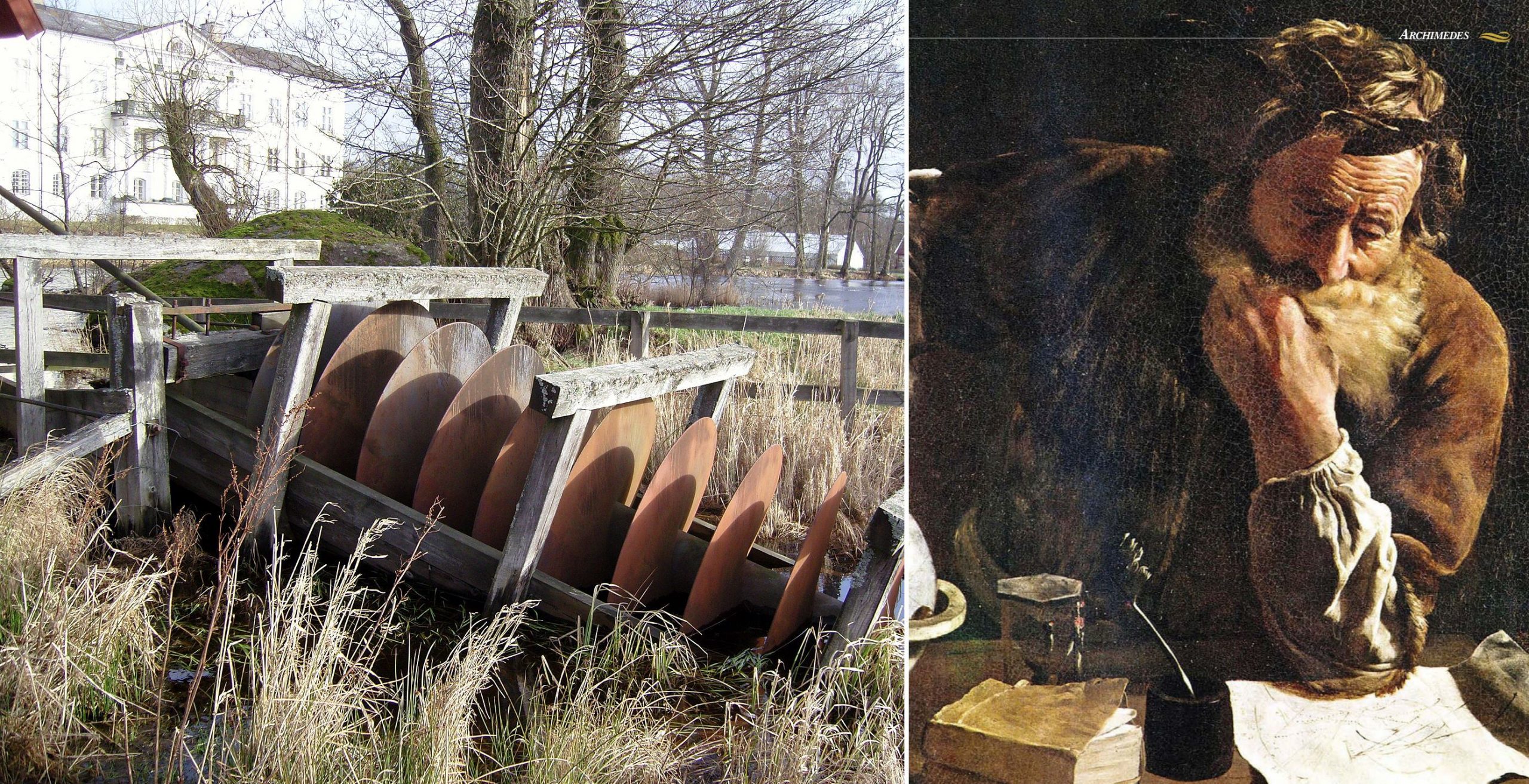
A weathered water-lifting mechanism sits quietly in tall grass by a calm waterway, its broad circular vanes stacked in a sturdy wooden frame. The scene feels almost pastoral—bare trees, pale light, and the hint of buildings in the distance—yet the machinery anchors it in the long story of practical engineering. Even without motion, the geometry of the wheel-like elements suggests a device meant to tame water and make it climb.
On the right, a contemplative depiction of Archimedes leans over papers and instruments, reminding readers that ancient innovation often began at a desk before it reached the field. The post title points to the famed Archimedes’ screw, a simple but powerful concept: a helical surface turning inside a cylinder to raise water from a lower level to a higher one. Whether used for irrigation, drainage, or moving water in confined channels, the idea became one of history’s most enduring inventions because it married elegant mathematics with everyday need.
Together, the paired visuals bridge theory and labor, showing how an ancient principle echoes through later waterworks and rural technology. Readers interested in the history of inventions will recognize the Archimedean screw as a cornerstone of classical engineering and a forerunner to modern pumps and conveyors. It’s a reminder that the ancient world didn’t just leave philosophies behind—it also left machines that continued to shape landscapes and livelihoods for centuries.