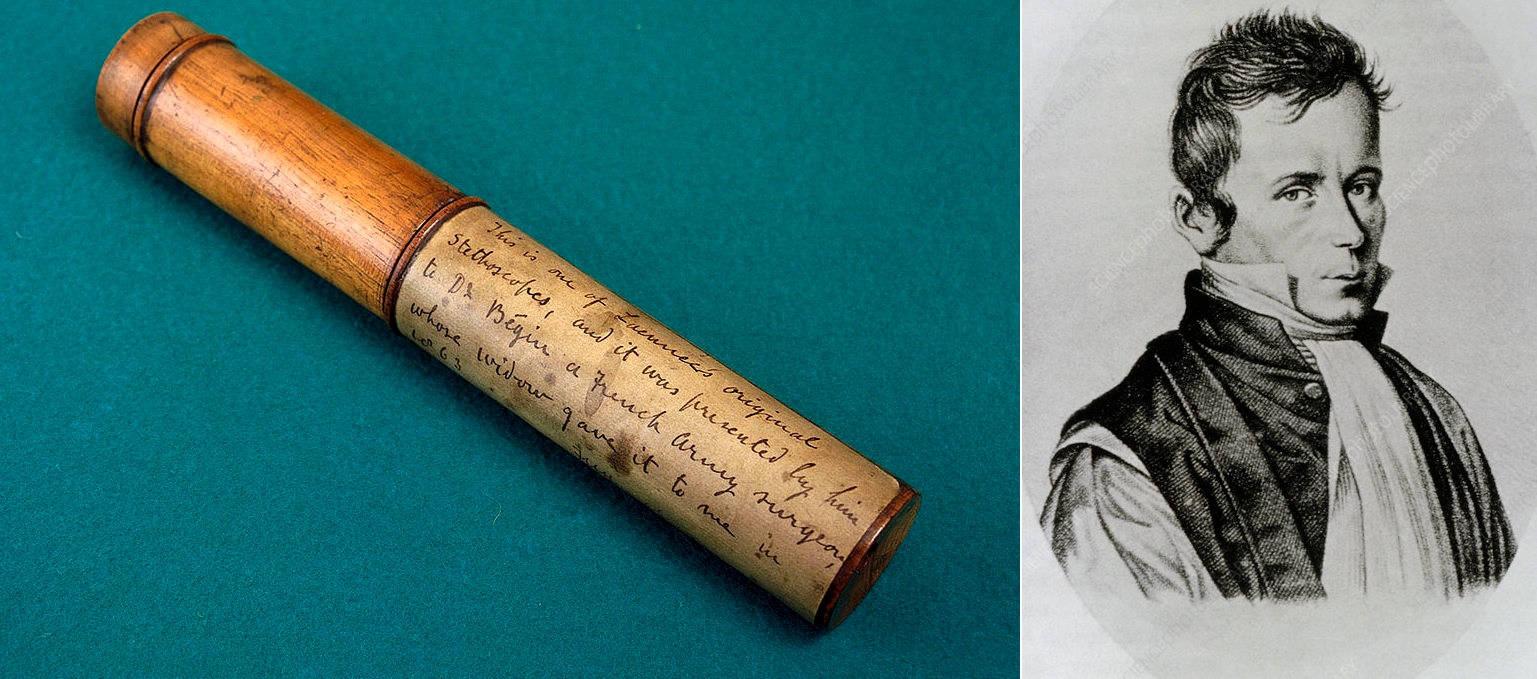
A smooth wooden cylinder rests against a teal background, its surface warm with age and marked by a handwritten label—an early stethoscope of the kind associated with René Laennec’s 1816 breakthrough. Unlike today’s flexible, binaural instruments, this monaural design looks closer to a craftsman’s tool than a piece of hospital equipment, yet it represents a turning point in how physicians learned to “listen” to the body. The close, simple form draws attention to the material reality of medical invention: wood, careful turning, and practical ingenuity.
To the right, a drawn portrait of Laennec anchors the object in human biography, showing a composed figure in formal early-19th-century dress. Pairing inventor and invention in one frame helps explain why the stethoscope became more than a gadget—it was a new method, a new habit of observation, and a new relationship between doctor and patient. Even without visible text beyond the label on the instrument, the visual juxtaposition tells a familiar story of medicine’s shift toward systematic diagnosis.
In the history of inventions, few items are as instantly symbolic of healthcare as the stethoscope, and this early example underscores how radical its first appearance must have seemed. It invites readers to imagine quieter exam rooms, tentative experiments with sound, and the gradual building of clinical confidence through auscultation. For anyone browsing historical medical images or the origins of diagnostic tools, this post highlights the moment when listening became an instrumented science.