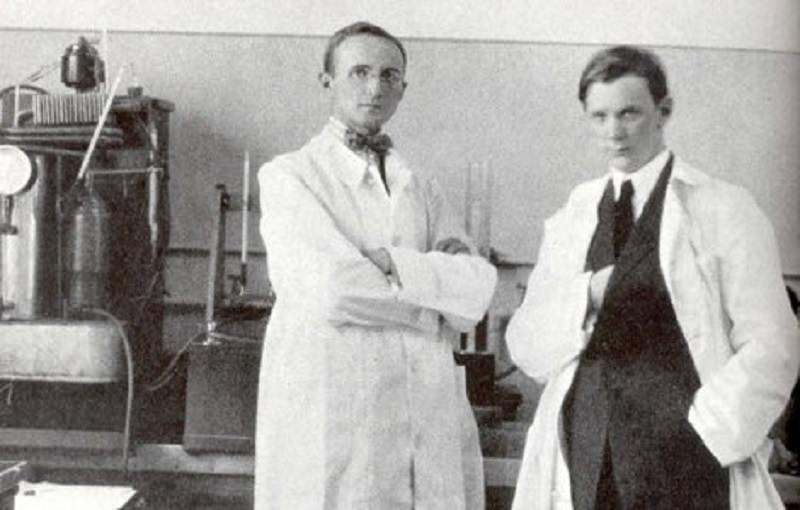
Two men in white lab coats stand with a quiet confidence beside a dense cluster of pipes, cylinders, and gauges—an improvised-looking machine that hints at a breakthrough in progress. Their formal posture contrasts with the tangle of industrial hardware behind them, suggesting a moment when refrigeration was still experimental, mechanical, and proudly on display. The title points to the refrigerator associated with Baltzar von Platen and Carl Munters, and the scene reads like a workshop or laboratory where modern cooling was being engineered into existence.
On the left, the equipment dominates: sturdy metal vessels, vertical tubing, and fittings arranged as if each part had been added to solve a practical problem—controlling temperature, pressure, and flow. Instead of the sleek appliances we know today, early refrigeration appears here as a system, a process made visible, with components exposed and accessible for testing. That openness is part of the story: inventions were not only built, they were demonstrated, inspected, and refined in spaces that looked more like industrial labs than kitchens.
Refrigeration changed daily life by extending food preservation, improving storage, and reshaping how households and businesses managed perishables, and images like this help anchor that transformation in real people and real machinery. For readers interested in the history of inventions and early 20th-century engineering, the photograph offers a candid glimpse of the era’s practical ambition—scientific attire, serious expressions, and a device that looks both intimidating and hopeful. As a WordPress post feature, “Refrigerator (1922) by Baltzar von Platen and Carl Munters” invites a closer look at the origins of cooling technology and the hands-on experimentation that made it commonplace.