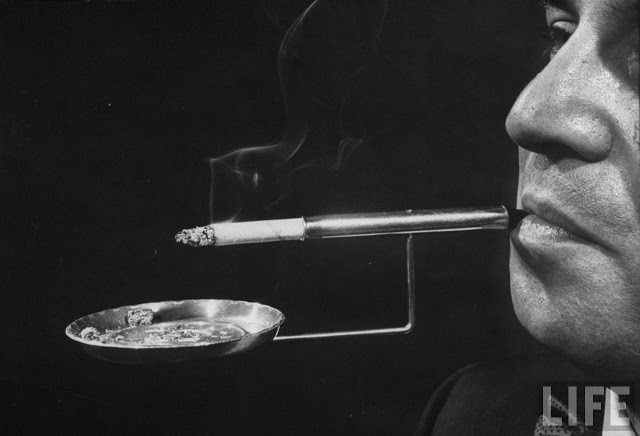
Balanced at the edge of a face, a cigarette juts forward from a rigid holder that ends in a shallow ashtray, turning smoke and falling ash into a tightly managed affair. The close-up composition emphasizes the gadget’s purpose: keep hands free, keep ash contained, and keep the ritual neat. A faint curl of smoke and the gritty texture of spent ash make the invention feel both practical and oddly theatrical.
Devices like this ashtray holder belonged to an era fascinated by clever add-ons for everyday habits, when “labor-saving” and “mess-saving” ideas could be marketed as modern convenience. The metal armature appears engineered to position the ashtray directly beneath the lit tip, catching debris before it lands on clothing, upholstery, or carpets. In a single frame, the photo hints at the constant negotiation between cleanliness, comfort, and the social ubiquity of smoking.
For anyone browsing historical inventions, this image offers a compact lesson in how consumer design follows culture as much as function. The appeal isn’t just the mechanism; it’s the promise of control over a habit that produced unavoidable byproducts. As a WordPress feature under the title “Ashtray Holder,” the photograph invites readers to consider how small contraptions once tried to refine everyday life—one ember, one ash flake, and one ingenious bracket at a time.