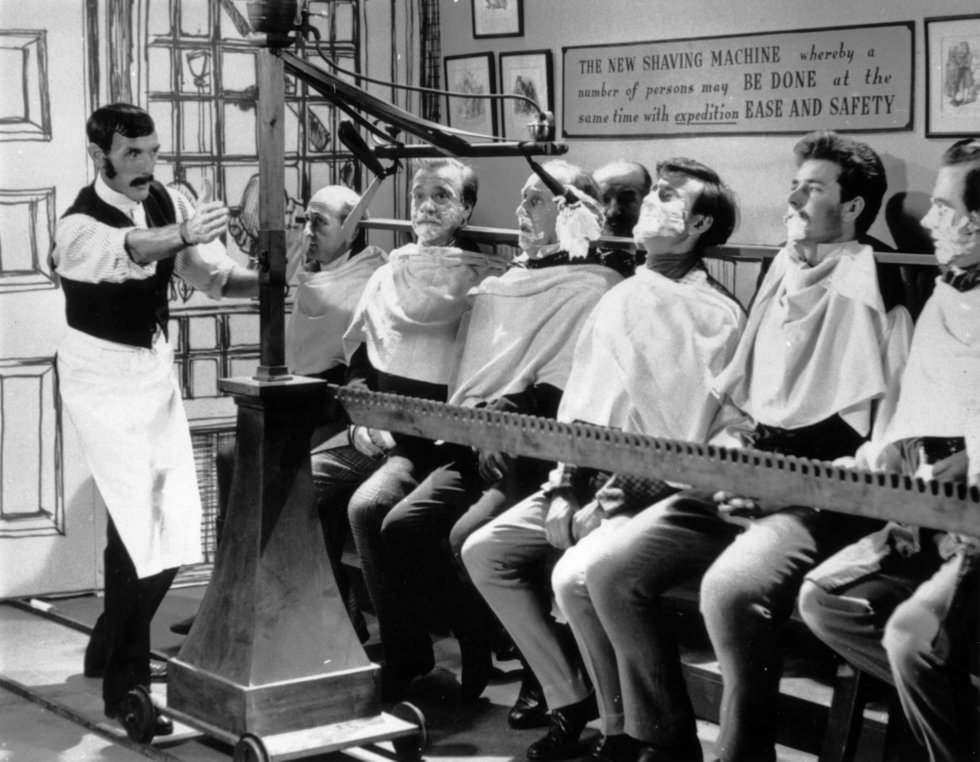
A barber stands at the left of the frame, hands poised as if conducting an orchestra, while a row of seated men brace themselves beneath an elaborate contraption of arms and fittings. Each customer wears a draped cape, faces tilted upward with that familiar mix of patience and doubt, as the “group shaving machine” hovers over them like a promise of speed. The workshop-like setting and crisp lighting turn an everyday ritual—getting shaved—into a spectacle of invention.
On the wall, a bold sign advertises a “NEW SHAVING MACHINE,” claiming that several people may be served at once “with expedition, ease and safety,” echoing the era’s faith in mechanization. The machine’s long bar and branching attachments suggest a synchronized system designed to standardize the shave, transforming personal grooming into a semi-industrial process. Whether intended as a serious labor-saving device or as a tongue-in-cheek demonstration, the scene captures how technology was marketed as the answer to time, cost, and convenience.
For anyone browsing historic inventions, barber shop history, or the evolution of men’s grooming, this photograph offers a striking snapshot of ingenuity—and the comic tension that often accompanied it. The lined-up clients, the careful staging, and the confident sales pitch all speak to a world eager to optimize even the smallest routines. “Group shaving machine” remains an unforgettable phrase because it condenses a whole period’s ambition into one improbable, razor-close idea.