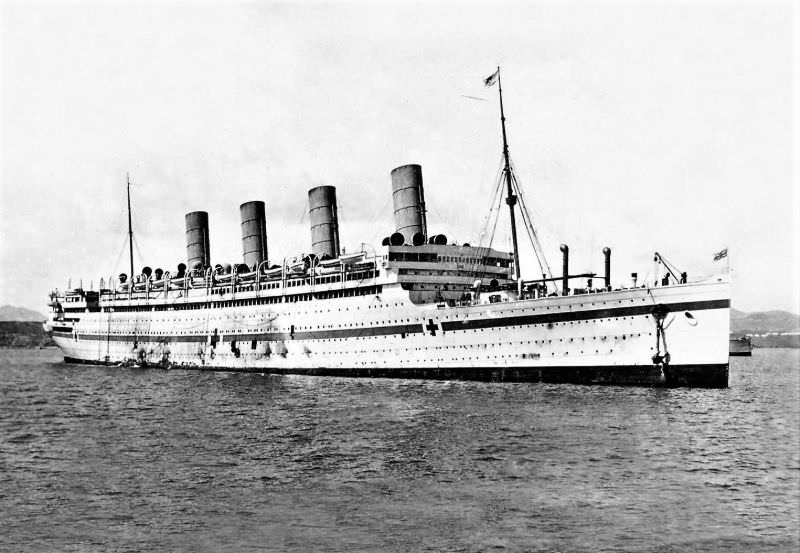
Moored off the Greek island of Lemnos on October 2, 1915, RMS Aquitania appears in her wartime guise as a hospital ship, the long white hull punctuated by large medical crosses that announce her protected role. Four towering funnels and a clean, liner-like profile still speak of speed and luxury, yet the calm sea around her feels less like an ocean crossing and more like a waiting room at anchor. In the distance, low shorelines and scattered craft hint at a busy operational setting just beyond the frame.
The transformation from glamorous passenger liner to floating medical facility is written across the ship’s sides: a vessel built for the Atlantic now marked for mercy in the Mediterranean. Aquitania’s commercial life had barely begun after her maiden voyage to New York in May 1914, only to be interrupted as war redirected ships, crews, and engineering toward urgent new purposes. Details such as the open deck spaces, lifeboats, and the crisp paintwork help explain why this particular liner could be adapted to carry wounded men and medical staff with relative efficiency.
For readers searching maritime history, World War I hospital ships, or the story of Aquitania herself, this photograph offers a striking snapshot of how quickly modern technology could be repurposed. The ship’s sleek design—born from competition and innovation—suddenly served evacuation, triage, and recovery, linking naval logistics with humanitarian necessity. Seen off Lemnos, Aquitania stands as a reminder that the era’s grand liners were not only symbols of travel and prestige, but also instruments pressed into service when history demanded it.