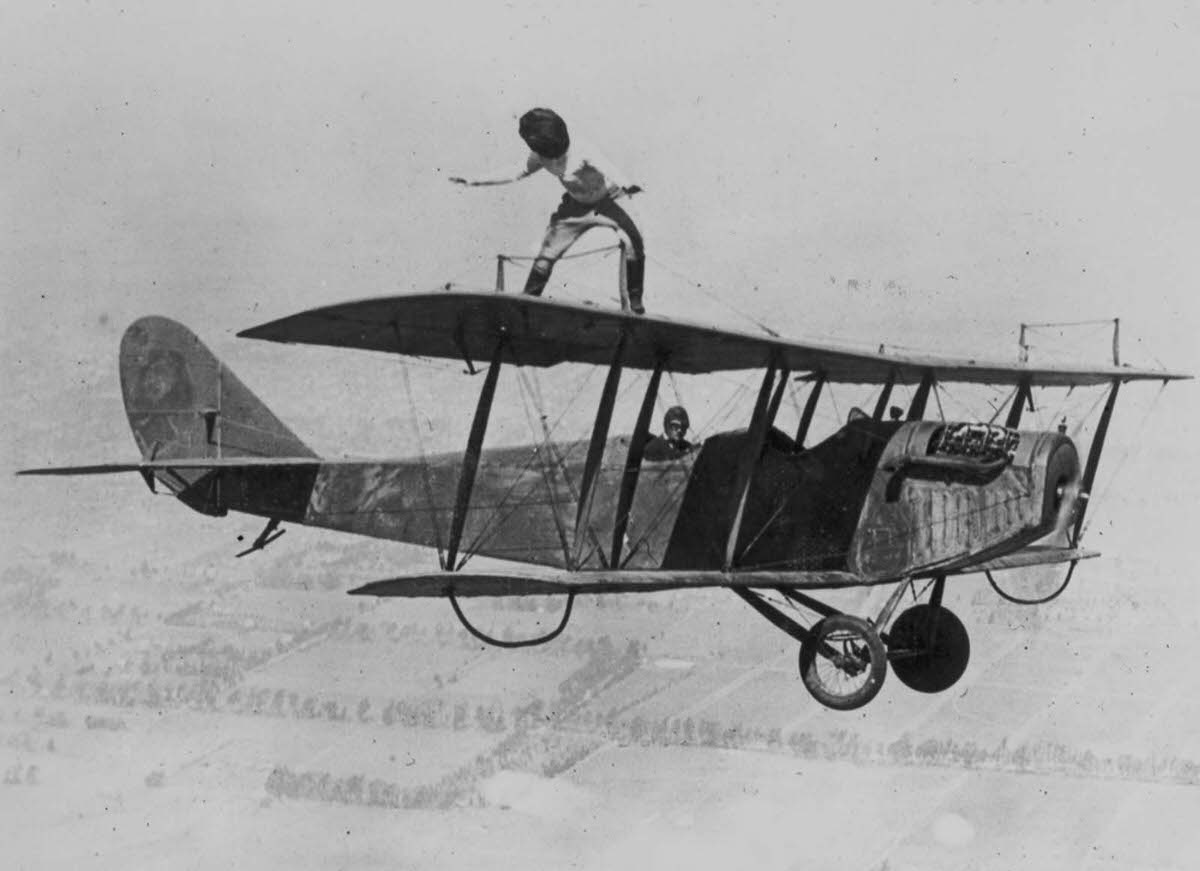
High above a hazy Los Angeles horizon, Gladys Roy balances on the upper wing of a Curtiss JN-4 “Jenny,” her stance braced against the wind and the vibration of the engine. A blindfold covers her eyes, turning an already perilous wing-walking act into something almost unimaginable, while the pilot remains tucked in the open cockpit below. The biplane’s struts, wires, and fabric surfaces—so familiar to early aviation—become a narrow stage where a single misstep could mean disaster.
Stunts like this thrived in the barnstorming era, when airshows and traveling pilots fed the public’s appetite for speed, spectacle, and modernity. The “Jenny,” a workhorse aircraft often associated with early flight training, appears here not as a classroom tool but as a platform for daredevil performance, its simple construction exposing just how little separated performer and sky. Roy’s blindfolded walk speaks to a time when aviation was still new enough to feel miraculous—and dangerous enough to make headlines.
Seen today, the photograph is more than a shock of adrenaline; it’s a window into 1920s aviation culture and the marketing of risk as entertainment. The stark composition—aircraft suspended in open space, figure poised atop the wing—captures the blend of engineering, bravado, and public fascination that helped define early flight in America. For readers searching for Los Angeles history, barnstorming, wing walking, or the Curtiss JN-4 Jenny, this image remains an arresting reminder of how the age of flight was sold to the crowds: one breathtaking stunt at a time.