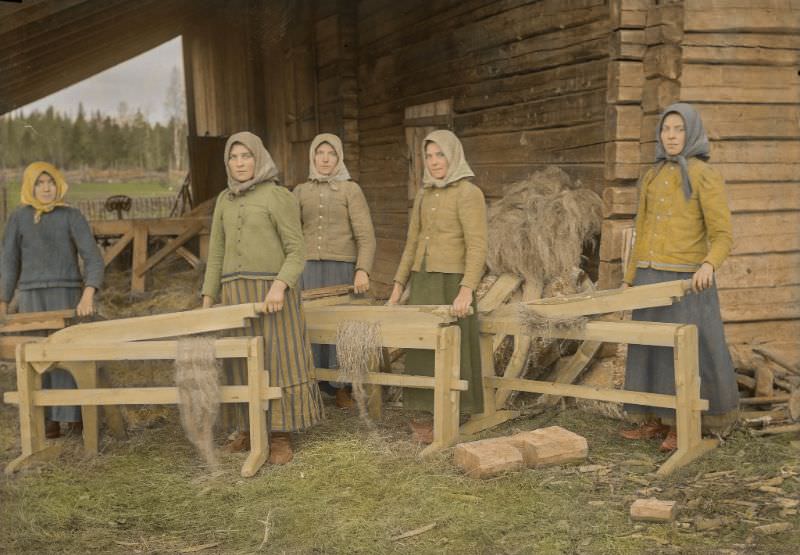
Beneath the eaves of a timber outbuilding in Pörtom, a small work crew stands poised over long wooden flax-processing frames, their headscarves and sturdy skirts signaling a day devoted to practical labor rather than ceremony. The colorization brings out the muted greens, ochres, and slate blues of everyday clothing, while loose bundles of pale fiber spill across the benches like combed hair. Behind them, rough-hewn boards, stacked wood, and a glimpse of fields and treeline situate the scene firmly in rural Ostrobothnia, within a Swedish-speaking corner of Finland where household production remained central to community life.
Flax was more than a crop here; it was a chain of tasks that turned plant stalks into linen for shirts, sheets, sacks, and workwear, and the equipment in view hints at those stages of preparation. The long frames and the hanging wisps suggest fiber being cleaned and aligned—work that demanded patience, strong hands, and a practiced eye for what was ready and what still needed pulling, breaking, or combing. Even without hearing the scrape of tools or the rustle of dried stems, the photograph conveys the rhythm of seasonal work carried out close to home, often in shared spaces where skills were passed along as naturally as conversation.
What makes this 1912 moment so compelling is how it preserves the material culture of Finnish village life: the carpentered simplicity of the tools, the utilitarian yard, and the quiet confidence of the workers facing the camera. For readers searching for early 20th-century Finland, Ostrobothnia history, Swedish-speaking communities, or traditional flax and linen production, the image offers an unusually tangible entry point. The added color doesn’t modernize the past so much as narrow the distance, letting the textures of wood, fiber, and cloth speak clearly across more than a century.