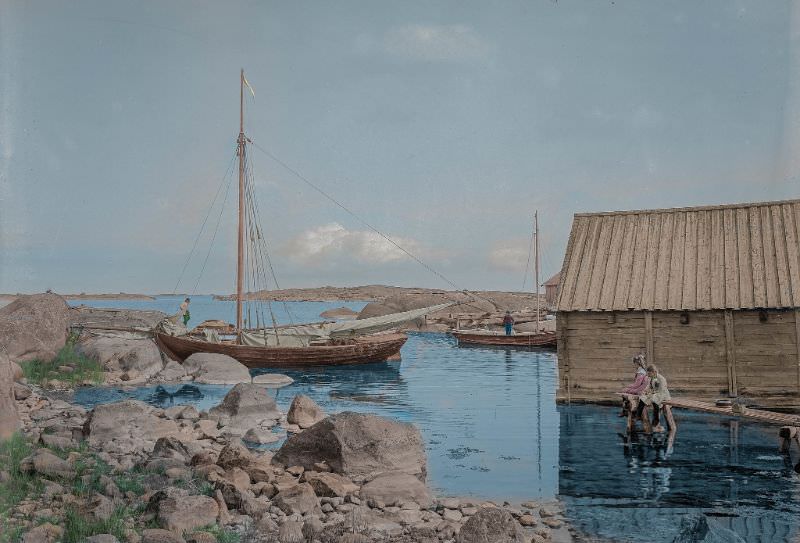
Soft pastel colorization lends the 1910 Åland archipelago a calm, lived-in presence, where smooth granite boulders meet still, blue water in a sheltered inlet. Two sailing boats rest close to shore, their masts and rigging drawing clean lines against a pale sky, while low skerries sit on the horizon like stepping-stones across the sea. The scene feels unhurried, defined by light, weather, and the quiet geometry of boats at anchor.
Along the right edge, a weathered wooden boathouse stands at the waterline, its simple roof and plank walls reflecting a practical island life built around the shoreline. Nearby, figures linger on a small landing or platform, suggesting everyday tasks—checking gear, watching the boats, or simply enjoying the warm day. The rocky foreground, dotted with sparse grasses, underscores how closely work, home, and nature were interwoven in maritime communities.
For readers interested in early 20th-century Scandinavian coastal life, this photograph offers an intimate glimpse of summer in the Åland islands, where sail and small craft shaped both travel and trade. The colorization highlights textures that monochrome often hides: sun-warmed timber, cool water, and stone worn smooth by generations of tide and wind. As a historical photo of the Åland archipelago, it invites lingering—listening for the creak of rigging and the soft lap of water against the dock.