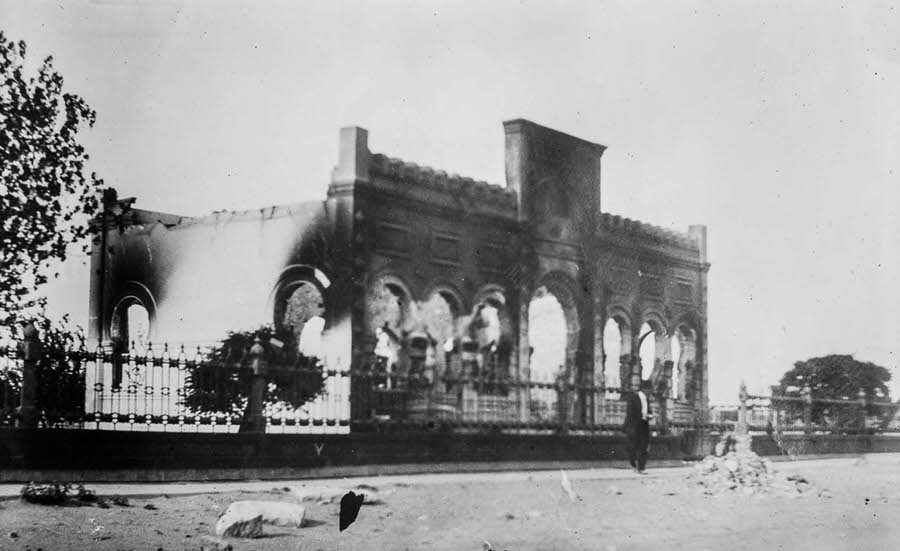
Across a wide, dusty street in Ciudad Juarez, a once-stately library stands scarred by battle, its roofline broken and its arched openings left gaping to the sky. Soot-darkened masonry and jagged voids suggest where shells or fire tore through walls meant for quiet study. Even at a distance, the building’s decorative brickwork and repeated arches hint at the civic pride it once represented—now interrupted by damage that turns architecture into evidence.
In the foreground, scattered debris and a lone figure on the roadway emphasize how abruptly normal life can be displaced during civil wars. The iron fence still traces the boundary of the property, a fragile sign of order against the disorder that has reached right into a public institution. Details like the empty window bays and collapsed sections invite the viewer to imagine what happened inside: reading rooms exposed, shelves and documents at the mercy of violence and weather.
A Ciudad Juarez library damaged by battle is more than a ruin; it’s a reminder that conflicts often target—or simply consume—the spaces where communities gather, learn, and preserve memory. As a historical photo, it documents the physical cost of unrest while also underscoring the cultural loss when education and public life become collateral. For anyone exploring Ciudad Juarez history, civil war imagery, or wartime damage to civic buildings, this scene captures the uneasy silence that follows fighting, when a city begins counting what has been broken.