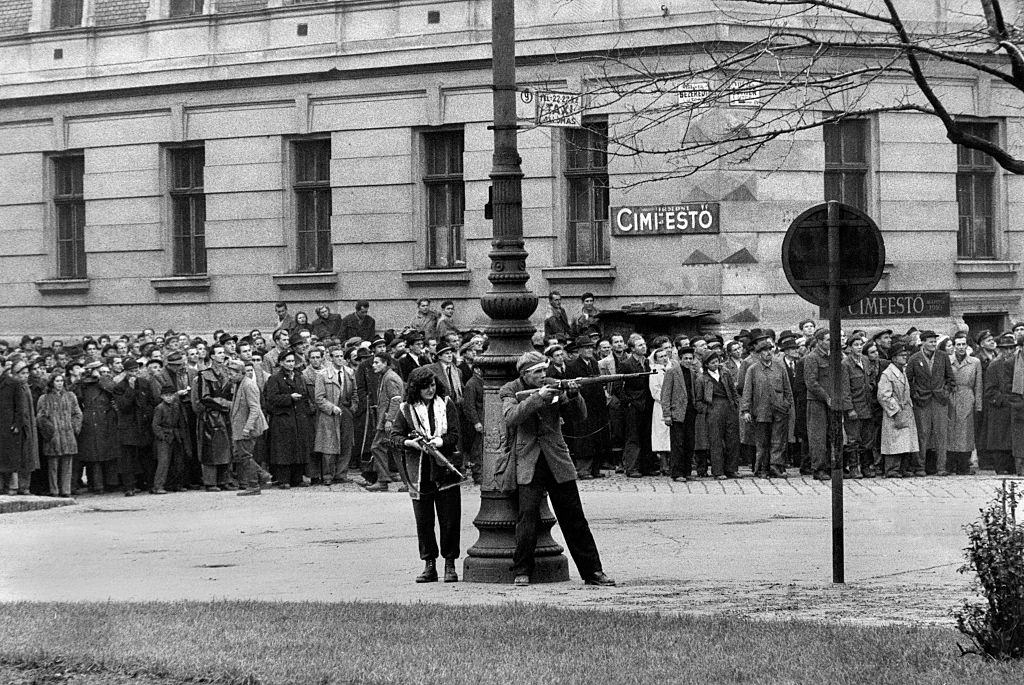
Budapest in November 1956 appears here as a tense crossroads where ordinary streets became a front line. A packed crowd presses against the façade of a stone building, their faces turned toward the open roadway as if waiting for the next sound to break the hush. The Hungarian word “CIMFESTO” on a shop sign anchors the scene in everyday city life, making the sudden presence of armed resistance feel even more jarring.
Near the center, two figures take cover by a lamppost, rifles leveled toward an unseen threat, while the onlookers behind them form a wall of witnesses. Coats, caps, and workwear suggest civilians drawn into the upheaval, not a distant professional army. The contrast between the calm geometry of windows and masonry and the improvised stance of combatants captures the fragile boundary between routine and revolt.
As part of the Hungarian Revolution of 1956—often described as a revolt of the Hungarian people against Soviet tyranny—this photograph evokes the atmosphere of civil conflict that can erupt within a city overnight. It is an image of collective courage and fear, where solidarity gathers in public view and survival depends on quick decisions made in plain sight. For readers searching the history of Budapest 1956, Soviet repression, and the Hungarian uprising, the scene offers a stark, human-scale glimpse of resistance in the streets.