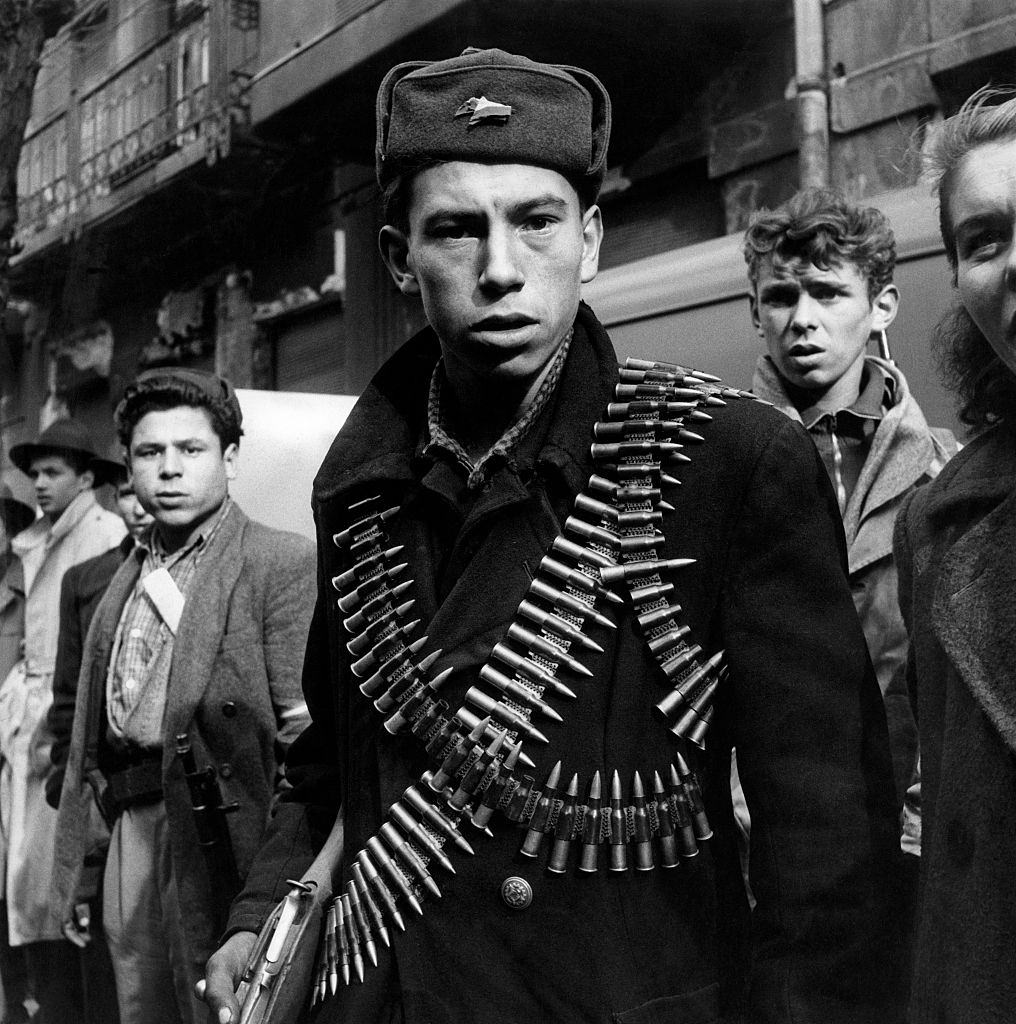
A young rebel stands in the foreground with an unblinking, hardened stare, his coat crossed by two heavy cartridge belts that glint against the dark fabric. The cap on his head sits slightly askew, and the ammunition draped over his chest turns his body into a stark symbol of urgency and improvisation. Behind him, other youths and onlookers crowd the street, their faces tense, as if the next sound could be a shouted warning or the crack of gunfire.
Set against the worn facades of an urban block, the scene hints at how quickly ordinary city space can become contested ground during civil unrest. The Hungarian Revolution of 1956 brought students, workers, and civilians into a fast-moving conflict where uniforms were scarce and resolve became a kind of identification. In that context, the belts of bullets read less like bravado and more like a grim necessity—evidence of a struggle being fought with whatever could be found, carried, and shared.
For readers exploring Cold War history, street-level resistance, or the visual record of uprisings, this photograph offers an intimate, human-scale view of revolution. It captures the collision of youth and violence, and the way a single expression can convey fear, determination, and disbelief all at once. As a historical image of the Hungarian Revolution, it invites us to look past slogans and strategy and consider the individuals who bore the weight of decisions made in moments when history tightened its grip.