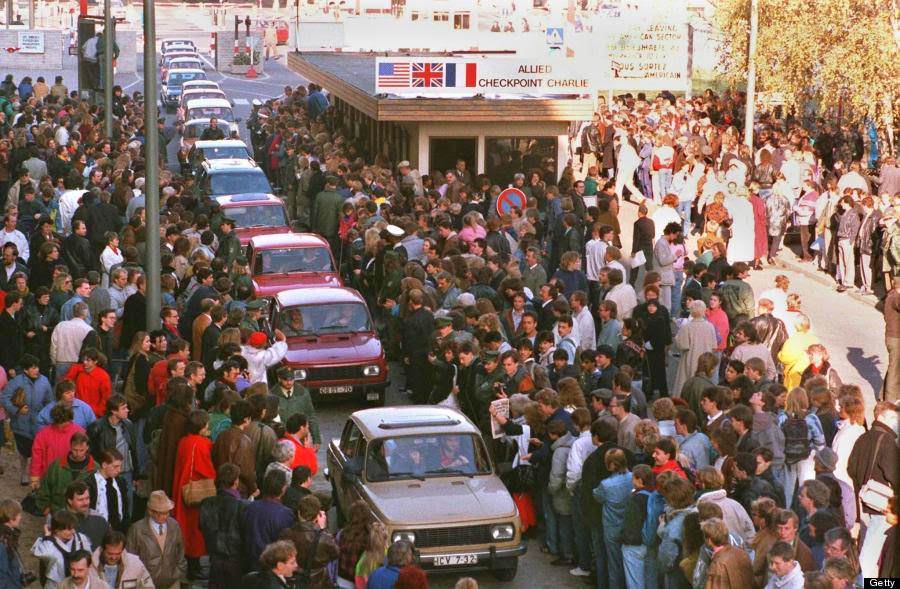
A river of compact Trabant cars inches forward through the narrow lane at Checkpoint Charlie, hemmed in by dense crowds that spill to the curb and lean toward the roadway. Above the booth, the familiar “Allied Checkpoint Charlie” signage and flags anchor the scene, while faces below turn toward the arriving motorists with open curiosity and excitement. The traffic is slow and tightly packed, but the mood is anything but tense—more like a street festival than a border crossing.
On 10th November 1989, the border that had long divided East and West Berlin suddenly became a place where ordinary people could meet, wave, and welcome one another in real time. The camera catches that fragile in-between moment: the old infrastructure of control still standing, yet overwhelmed by movement, noise, and emotion. In the sea of jackets and raised arms, the checkpoint looks smaller than its reputation, as if history itself is being crowded out by human presence.
For anyone searching the story of the Berlin Wall’s opening, this photograph offers a vivid snapshot of Cold War Europe turning a corner—Trabant convoys, West Berliners cheering, and a once-fearsome crossing transformed into a corridor of reunion. Details like the packed sidewalks, improvised vantage points, and the unbroken line of cars underscore how quickly the news translated into action. It’s an image of Berlin in transition, where a border becomes a threshold and celebration takes the place of separation.