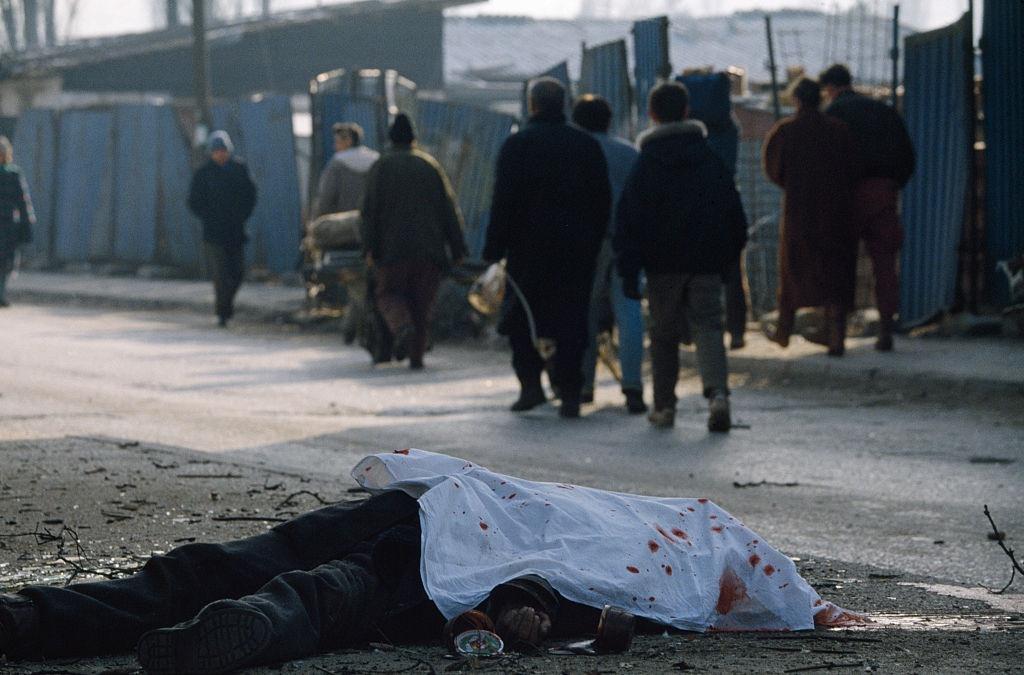
On a cold Sarajevo street in 1992, the war’s immediacy lies in the foreground: a body covered with a stained sheet, half on broken pavement, while daily movement continues in the distance. Bundled figures walk away under low winter light, their heavy coats and hunched shoulders suggesting temperatures as unforgiving as the conflict itself. Corrugated metal fencing and makeshift barriers frame the road, giving the scene the temporary, improvised look of a city forced to adapt hour by hour.
Winter hardship and civil war collide here in the most brutal way—life reduced to essentials, and death made public. The composition pulls the eye from the stillness at ground level to the slow stream of pedestrians, a contrast that speaks to siege-time routines: keeping going, finding food or fuel, crossing exposed stretches quickly. Even without visible landmarks, the title anchors the image in Sarajevo, inviting readers searching for Bosnian War history to consider how weather amplified every danger and deprivation.
For a WordPress post focused on historical photos, this frame works as both documentation and moral record, capturing the human cost behind headlines about the conflict. It evokes not only violence but also the exhaustion of a city enduring cold, scarcity, and constant threat, where mourning and survival occur side by side. Seen today, it remains a stark reminder that in wartime Sarajevo, the struggle was fought against bullets and winter alike.