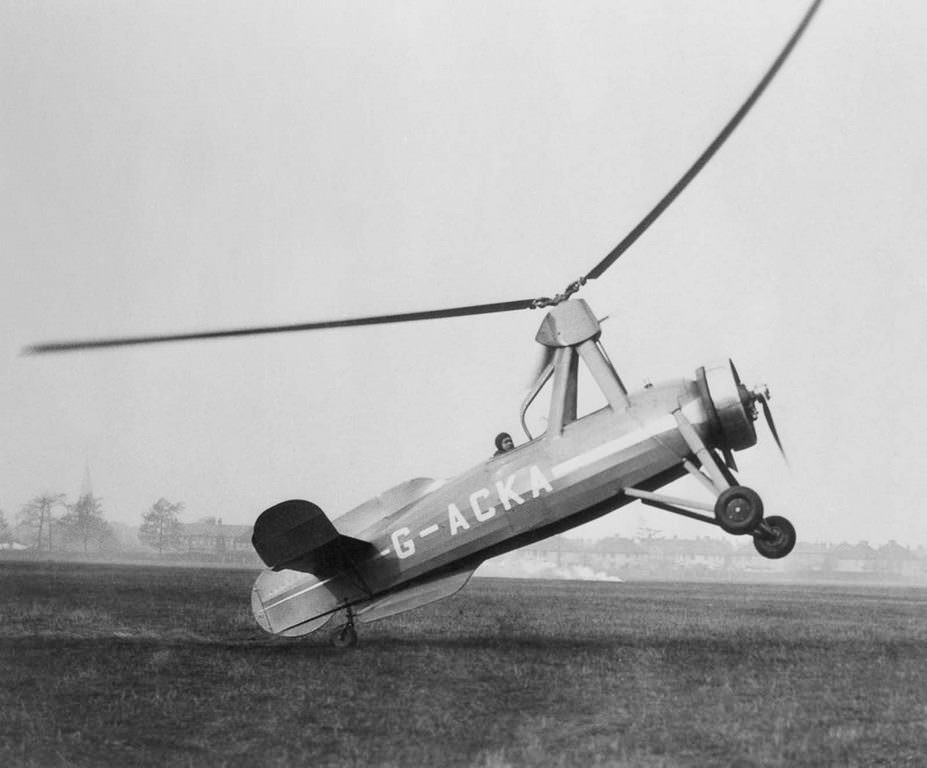
Balanced on its landing gear with the fuselage pitched upward, this wingless autogyro variant hints at the experimental daring of early rotary-wing flight. The overhead rotor dominates the frame, its blurred blades suggesting motion even in a still moment, while a tractor propeller sits at the nose to pull the machine forward. A registration marking is visible along the side, grounding the scene in real-world testing rather than a mere workshop curiosity.
Juan de la Cierva’s autogyro work helped bridge the gap between fixed-wing airplanes and the helicopter era, and the “wingless” concept makes that transition especially vivid. Removing conventional wings places the emphasis on autorotation and the rotor system’s ability to sustain lift, reflecting a period when engineers were still negotiating how best to tame low-speed stability and short-field performance. The aircraft’s compact tail surfaces and skeletal support structure read like purposeful engineering—lightweight, direct, and built to prove a point.
Seen against an open airfield with distant buildings softened by haze, the photo carries the atmosphere of 1930s aviation trials: practical, public, and quietly revolutionary. It’s an inventions story told in metal and fabric, where every strut, wheel, and blade speaks to iterative design. For readers searching the history of the autogyro, Juan de la Cierva innovations, or early rotorcraft development, this image offers a memorable snapshot of experimentation on the runway edge of modern flight.