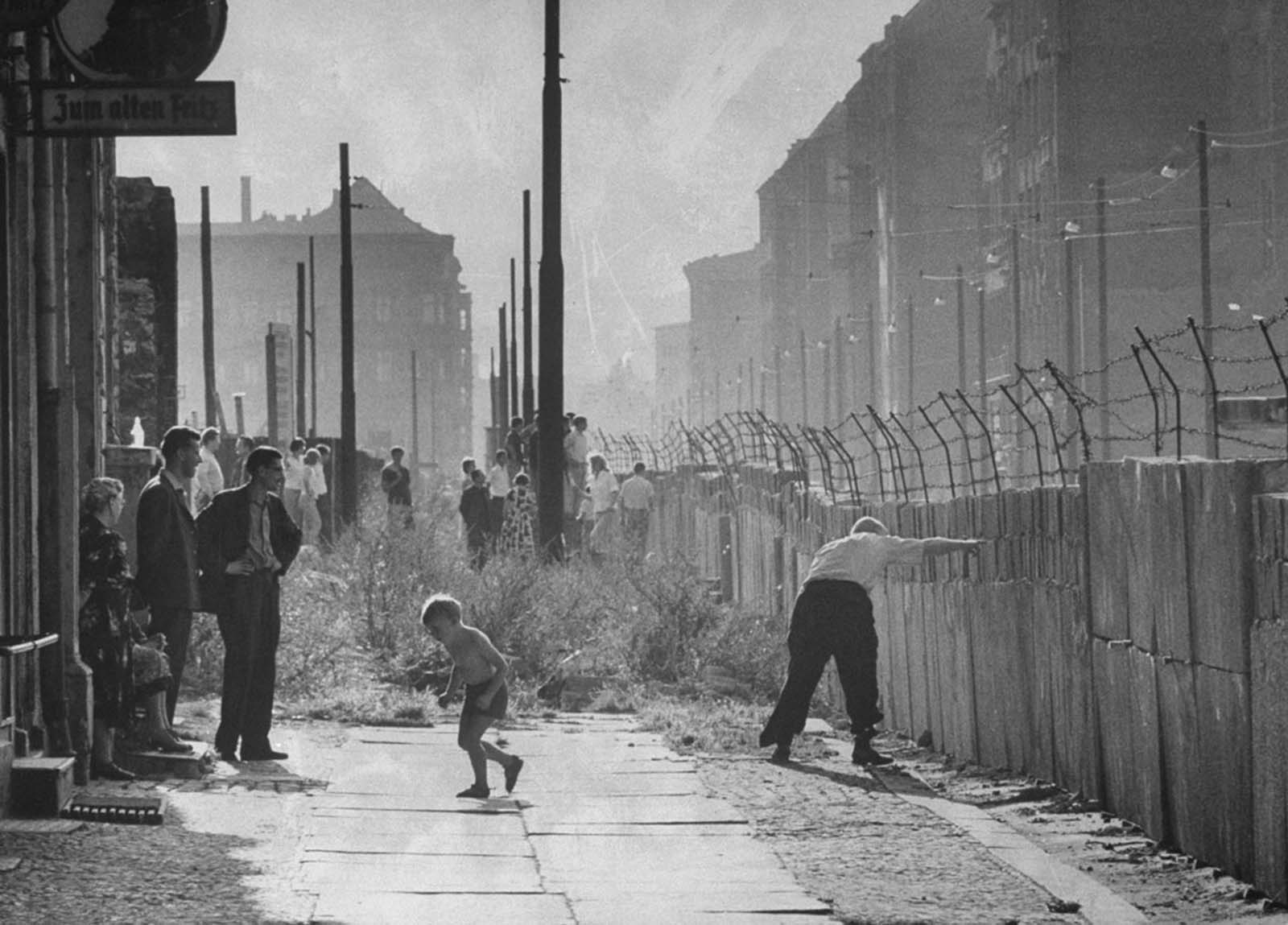
Along a sunlit West Berlin street in August 1961, everyday life collides with sudden geopolitics. A rough barrier of upright panels topped with barbed wire slices through the scene, still new enough to look improvised, yet already absolute. Men, women, and children gather on the pavement, their bodies angled toward the divide as if attention alone could bridge what has just been severed.
The details do the quiet work of history: a man leans forward to peer through gaps, others stand back with hands in pockets, and a child moves across the open space with the unguarded energy adults no longer have. Utility poles and long façades recede into haze, emphasizing how far the boundary stretches and how quickly a familiar neighborhood can become a frontier. Nothing here needs uniforms to feel tense; the wall’s earliest form is enough to reorder the street.
Seen today, the photo reads as a raw first chapter in the story of the Berlin Wall, when residents were still trying to understand what the Cold War meant at sidewalk level. It captures the moment West Berliners began gathering at the edge of separation—watching, waiting, and searching for signs of people on the other side. For readers interested in Berlin Wall history, August 1961, and the lived experience of a divided city, this image offers a stark, human-scale view of a barrier being born in plain sight.