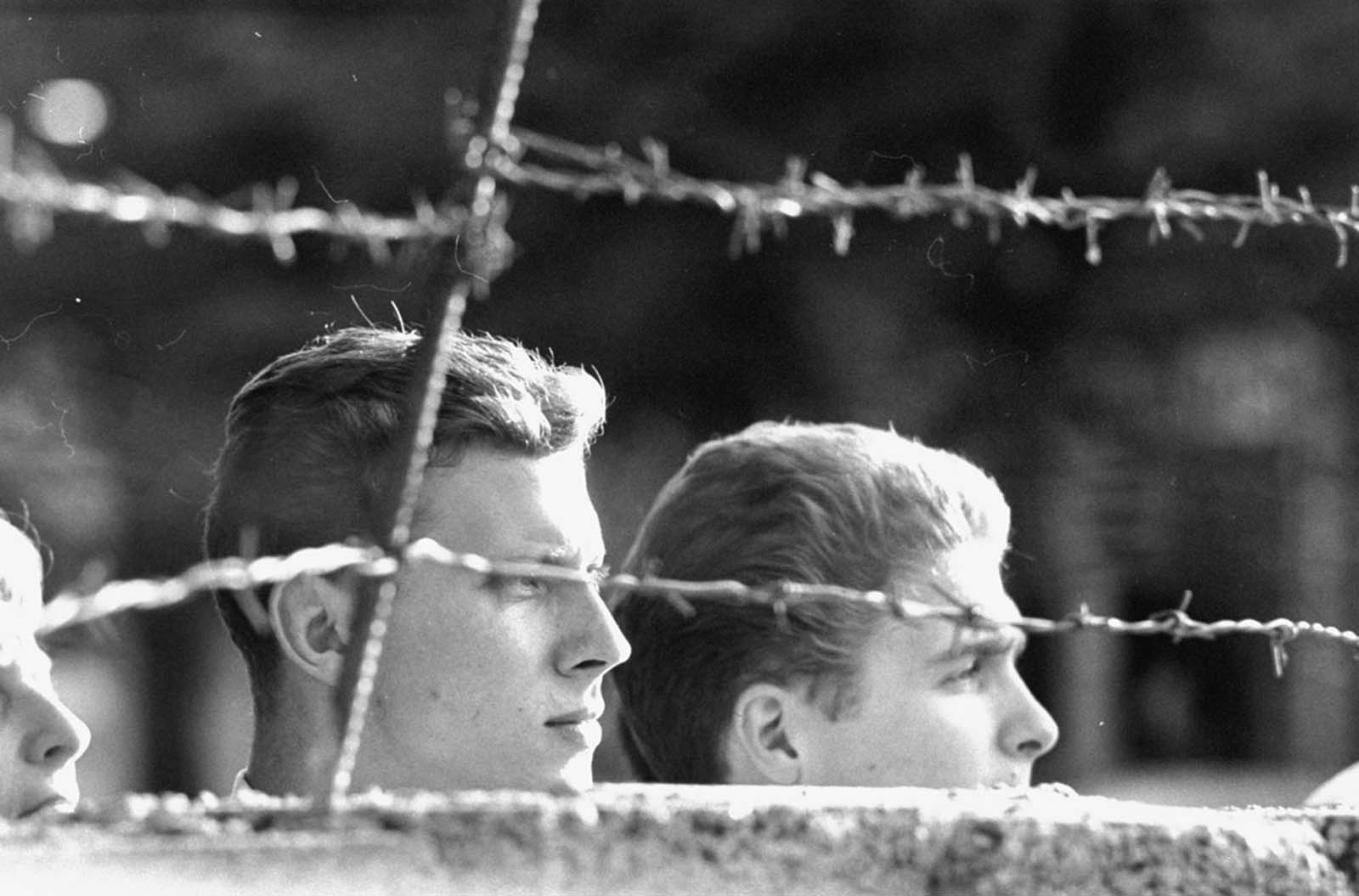
Barbed wire cuts hard lines across the frame as two West German men lean toward the edge of a newly raised barrier, eyes fixed on a point beyond the camera’s reach. The concrete lip in the foreground and the improvised fencing above it speak to a border being assembled in real time—still rough, still uncertain, yet already capable of turning an ordinary street into a frontier.
August 1961 was the moment Berlin’s Cold War tensions became a physical fact, and the Berlin Wall began as much with wire and blocks as with ideology. In this close, intimate view, the drama isn’t tanks or speeches but waiting: the quiet, stubborn vigil for relatives who had gone into the eastern sector and might not be allowed back. Faces are lit by sun, but the expressions carry the chill of sudden separation.
Seen today, the photograph reads like a lesson in how quickly political decisions can rewrite private lives. It’s a stark, SEO-friendly window into early Berlin Wall construction, border controls, and the human cost of division—families split, friendships interrupted, and a city forced to look at itself through barriers. For anyone searching the history of East and West Germany, this moment captures the first days of a boundary that would define an era.