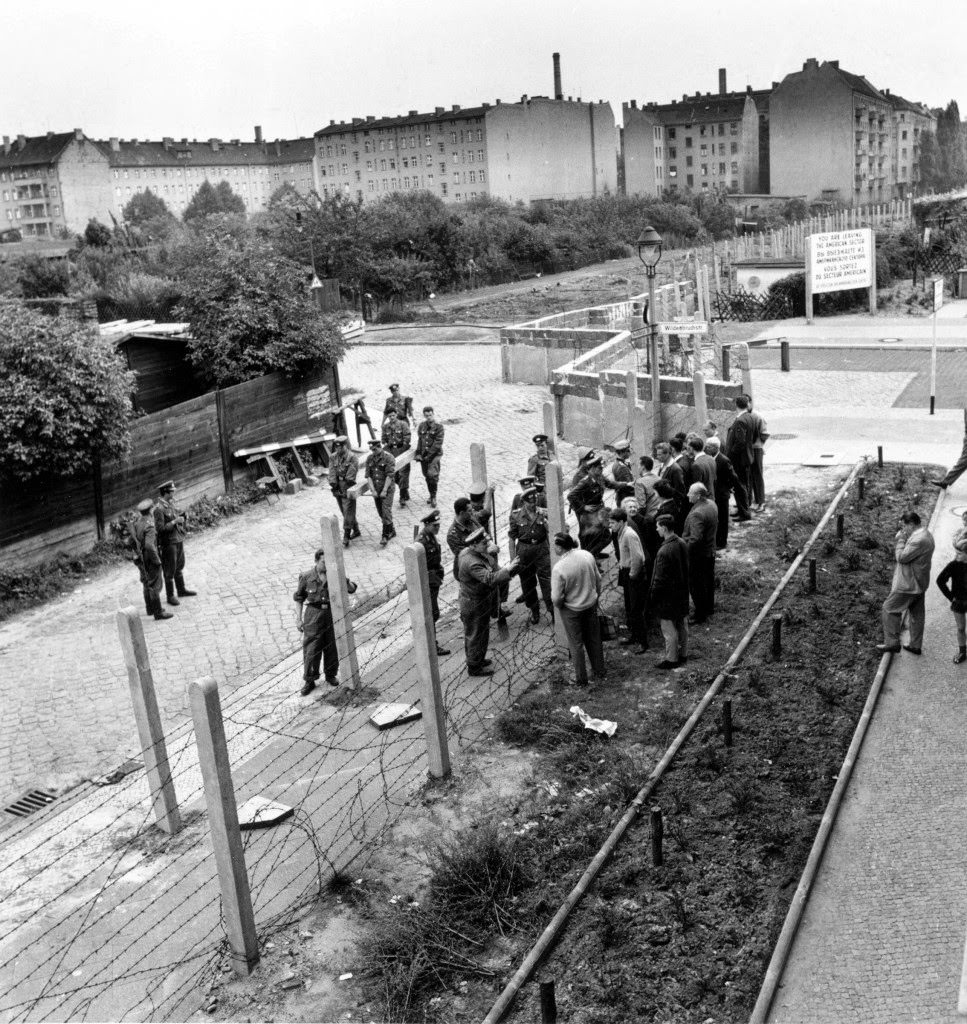
Along a raw strip of street and soil, a temporary border has been hammered into place: posts, barbed wire, and watchful uniforms dividing one Berlin block from the next. On the near side, West Berliners cluster close to the fence, leaning in as if distance could be argued away; opposite them, East Berlin policemen stand in a loose line, listening, answering, holding their ground. Behind the standoff, everyday apartment facades and a quiet lamp post underline how suddenly ordinary neighborhoods were turned into a frontier.
The tension here isn’t only in the wire but in the body language—hands raised in explanation, heads tilted to catch words over the barrier, a crowd forming because news travels fast when families and friends are cut off. The barrier looks improvised, yet it already controls movement and conversation, turning a shared street into contested space. Even at this early stage, the border carries the unmistakable logic of the Cold War: separation enforced not just by policy, but by men on patrol and civilians pressing up to the limits.
Dated to September 1961, the scene belongs to the first weeks after the Berlin Wall’s construction began, when the line was still being tightened and tested. Photographs like this are valuable precisely because they show the transition from open city to divided city in real time—before concrete dominated the skyline, when barbed wire was enough to transform daily life. For readers searching Berlin Wall history, East and West Berlin border photos, or Cold War Germany imagery, this moment captures the human scale of partition: conversation reduced to shouting across a fence.