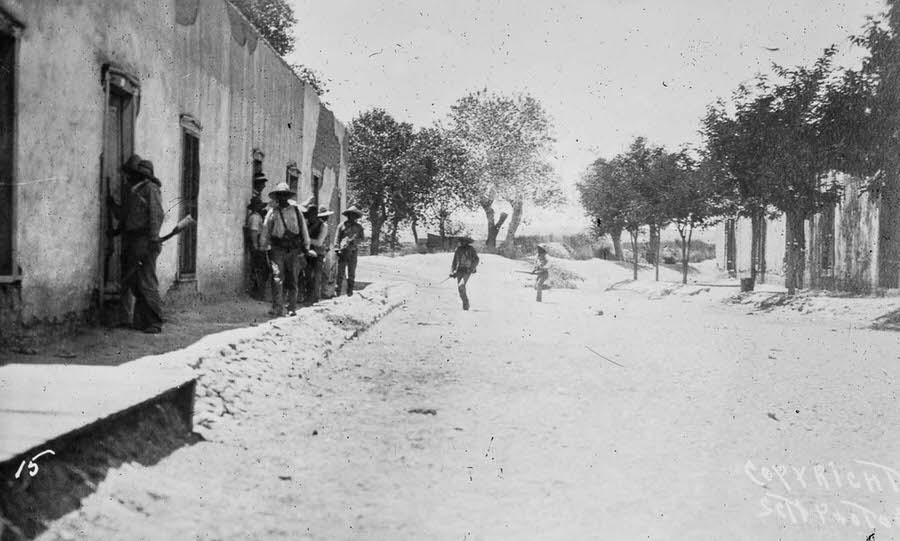
Dust hangs over a broad Juarez street as two rebel fighters sprint through open ground, bodies pitched forward with the urgency of incoming fire. Along the left wall, a cluster of armed men presses into the thin shade of an adobe building, rifles held ready, hats low, and backs tight to the plaster. The road itself feels exposed and silent, lined with sparse trees and low structures that offer little cover once the dash begins.
What stands out is the contrast between movement and waiting: runners gamble on speed while others hold position at doorways and corners, turning architecture into protection. The scene reads like a street-level lesson in urban combat during civil wars, where a single block can become a frontline and every window or wall suggests an unseen opponent. Even without visible muzzle flashes, the posture of the men and the staggered sprint convey the pressure of a firefight.
For readers drawn to Mexican Revolution-era conflict photography and borderland history, this image anchors the title’s drama in everyday details—sun-bleached facades, a rough road, and fighters improvising tactics in the open. It also invites a closer look at how Juarez streetscapes shaped encounters between rebels and their enemies, making geography as decisive as firepower. As a historical photo, it preserves an instant when courage, fear, and calculation collided in the space between one wall and the next.