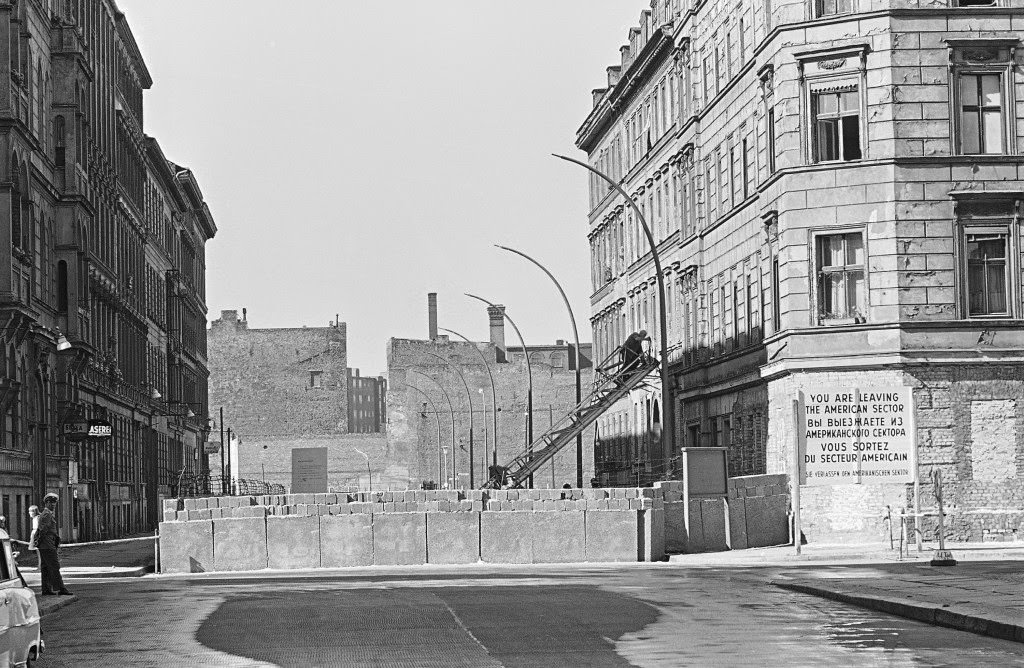
Sebastian Strasse becomes a hard edge in this 1961 view of divided Berlin, where a fresh concrete barrier blocks the roadway and reshapes the everyday geometry of the city. The street recedes into the distance between tall apartment façades, but movement is stopped cold at the wall—an abrupt interruption that turns an ordinary intersection into a political boundary.
On the right-hand building, a stark warning—“YOU ARE LEAVING THE AMERICAN SECTOR”—anchors the scene in the tense language of occupation and control, echoed in multiple languages for anyone approaching the crossing. Behind the border wall, workers raise powerful street lights, their arcing poles lined up like sentries; the machinery and scaffolding hint at speed and permanence, as if the division must be reinforced not only with concrete but with illumination and surveillance.
Viewed today, the photograph reads as an early snapshot of the Berlin Wall era, when infrastructure itself became a tool of separation between West Berlin and Soviet East Berlin. The empty street, the watchful signage, and the newly installed lighting together create a chilling, SEO-friendly window into Cold War Berlin, capturing how quickly borders could be built—and how completely they could alter urban life.