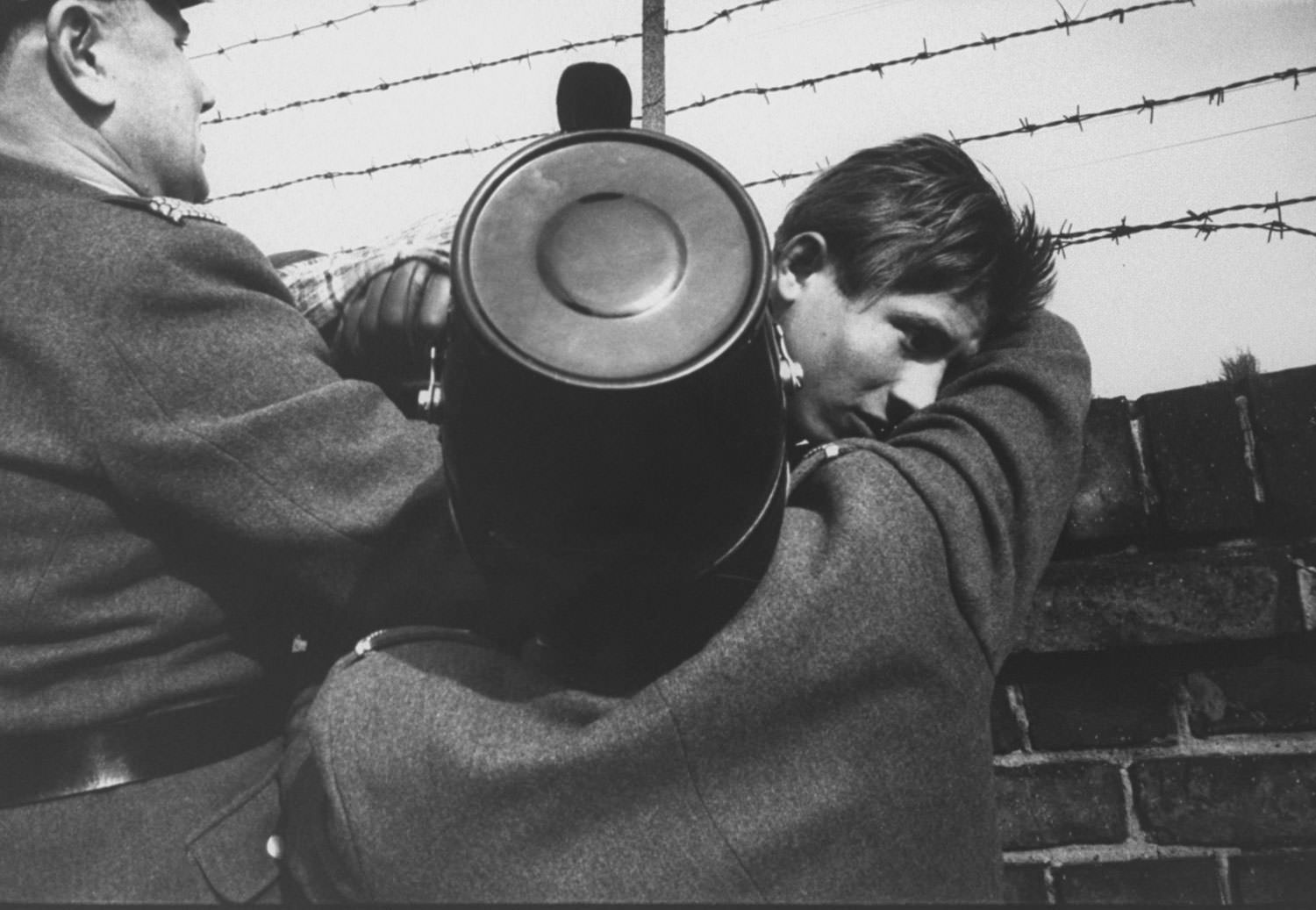
Barbed wire slices across the sky in hard, repeated lines, turning an ordinary brick edge into a frontier. In the foreground a teenage boy presses forward, his face tense and focused as he squeezes through the barrier, while a uniformed figure beside him looms close with a large circular piece of gear dominating the frame. The title’s account—an East German orphan, only 17, slipping into West Berlin after being waved on by West Berlin police—gives this moment the sharpness of a lived decision rather than a distant Cold War abstraction.
October 1961 was still early in the Berlin Wall’s life, when improvised fencing and fresh coils of wire could change overnight into a permanent-looking divide. The photograph hints at that unsettled phase: not yet the later concrete mass, but a militarized boundary already thick with threat and surveillance. It’s a scene that belongs to the broader story of escapes over the Berlin Wall, when a few feet of space could mean the difference between control and possibility.
What lingers most is the human scale of the crisis—one youth’s body angled to fit through a gap, a breath held, the consequences unknown until the crossing is complete. The police gesture described in the title adds a complicated note of agency and chance, a reminder that borders are enforced by people and sometimes punctured by split-second choices. For readers searching Berlin Wall history, East Germany escape stories, or daily life in divided Berlin, this image offers a concentrated, unforgettable glimpse of courage under pressure.