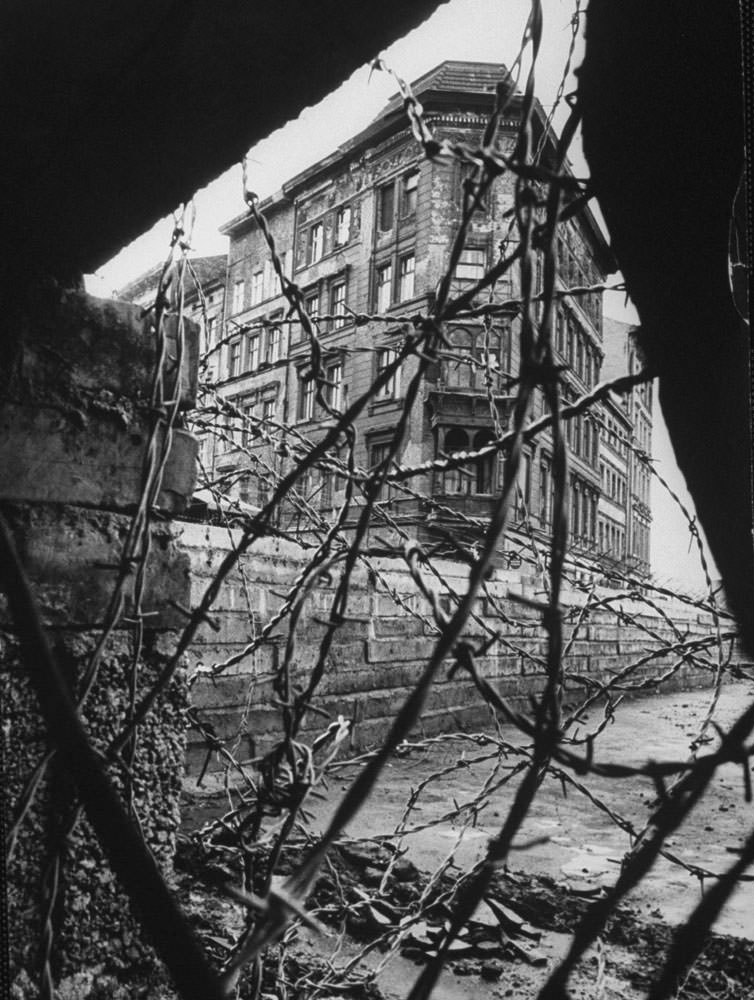
Barbed wire slashes across the foreground like a harsh signature, turning a ruined gap into a barricaded viewpoint. Beyond it, a large Berlin building rises with battered dignity—its façade still ornate, its windows staring out over a scarred street. Rubble and broken masonry at the edges of the frame hint at recent destruction, while the wire insists that the damage is no longer only physical.
January 1962 places this scene in the early, tense period after the Berlin Wall hardened from a sudden barrier into a fortified border. The photograph’s cramped perspective—peering through tangles of metal and jagged stone—conveys the feeling of being penned in, of ordinary urban space redefined by security lines and enforced separation. It’s a quiet but powerful Cold War image: architecture, debris, and fencing working together to tell the story of a city split into opposing worlds.
For readers searching the history of divided Berlin, this view offers more than documentation; it captures atmosphere. The barbed wire dominates not because it is the most massive object, but because it controls everything the eye can reach, turning a familiar cityscape into a forbidden distance. In a post about civil conflict and fractured societies, the photo stands as a stark reminder that modern “front lines” can run straight through neighborhoods—measured in rubble, silence, and a few strands of wire.