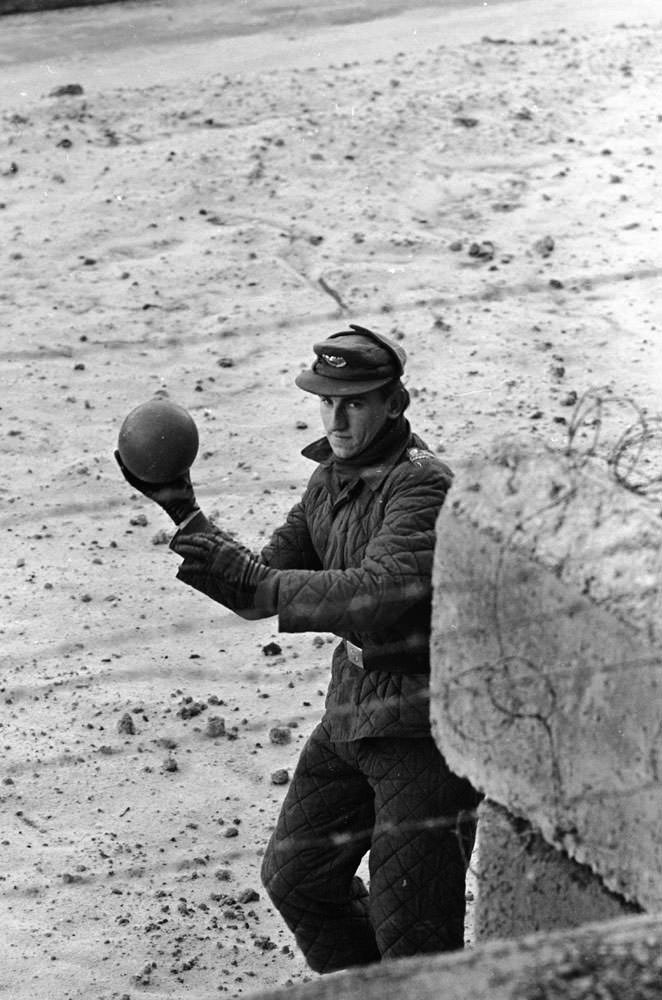
A single soldier stands in the dead ground beside the Berlin Wall, his quilted uniform and watchful expression set against a raw, sandy strip that feels more like a worksite than a neighborhood. In his gloved hands he holds a ball, paused mid-gesture as if weighing the simplest of choices while the concrete edge looms close by. The scene is quiet, almost ordinary, yet every detail hints at the hard border running through everyday life in divided Berlin.
In June 1962, not long after the Wall’s construction, such a no-man’s-land was engineered to separate East from West with distance, barriers, and constant supervision. The title’s small action—an East German guard throwing a child’s ball back to the West German side—cuts across that architecture of control with a moment of human reflex. It doesn’t erase the politics or the danger, but it reveals how even guarded frontiers were populated by people still capable of impulse, courtesy, or empathy.
For readers exploring Cold War history, the Berlin Wall, or the lived experience of German division, this photograph offers a powerful contrast between state boundaries and personal gestures. The ball becomes a modest symbol of childhood and normality, briefly bridging a line meant to be unbridgeable. In a post tagged by themes like civil conflict and separation, the image lingers as a reminder that walls are built in concrete, but they are felt most sharply in the smallest exchanges.