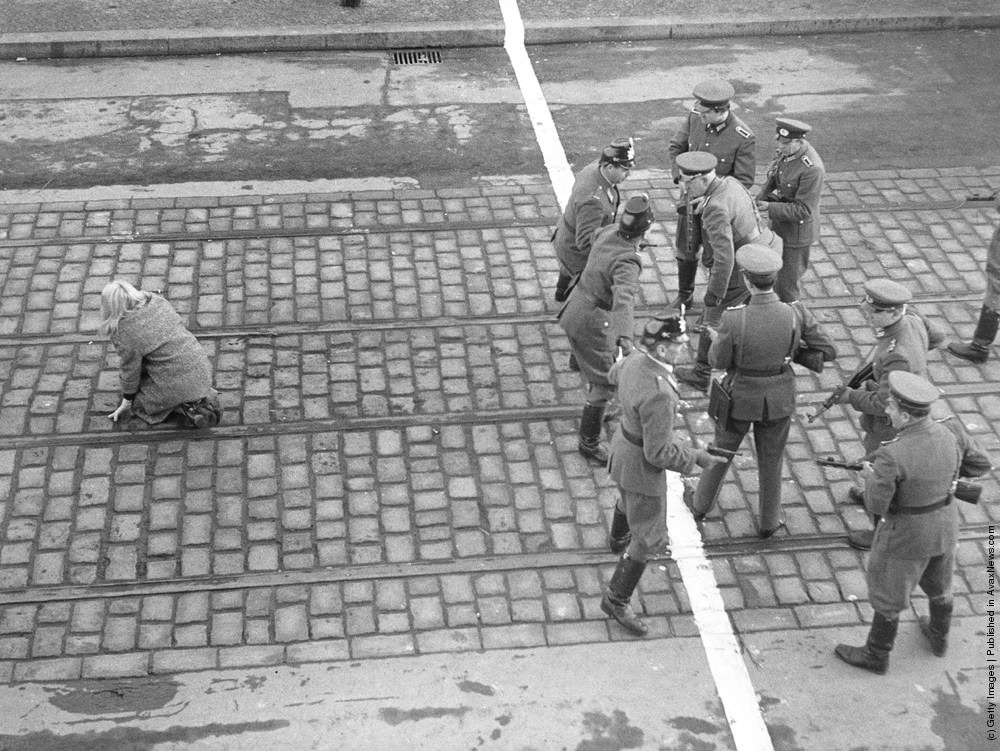
A stark painted line cuts across the cobblestones, turning an ordinary Berlin street into a stage for Cold War confrontation. On one side, West Berlin policemen stand tense and watchful; opposite them, East German Volkspolizei gather in uniformed formation, the distance between the groups measured in feet yet charged with political meaning. Tram tracks and worn paving stones emphasize how daily life continued under the shadow of division, even as authority faced authority.
Near the edge of the frame a lone figure crouches low, separated from the cluster of armed men, hinting at the human cost that borders impose on bystanders and residents. The officers’ posture and spacing suggest a controlled standoff rather than open violence, a moment when restraint mattered as much as force. Details like caps, coats, and long guns underscore how quickly a city could be militarized when lines on a map hardened into barriers on the ground.
For readers searching the history of Berlin’s border, this photograph distills the era’s uneasy balance: surveillance, protocol, and the constant possibility of escalation. It also illustrates why the city became a symbol of divided Europe, where policing was never purely local and every encounter carried international consequences. Seen today, the scene reads like a quiet warning about how borders can transform familiar streets into frontiers overnight.