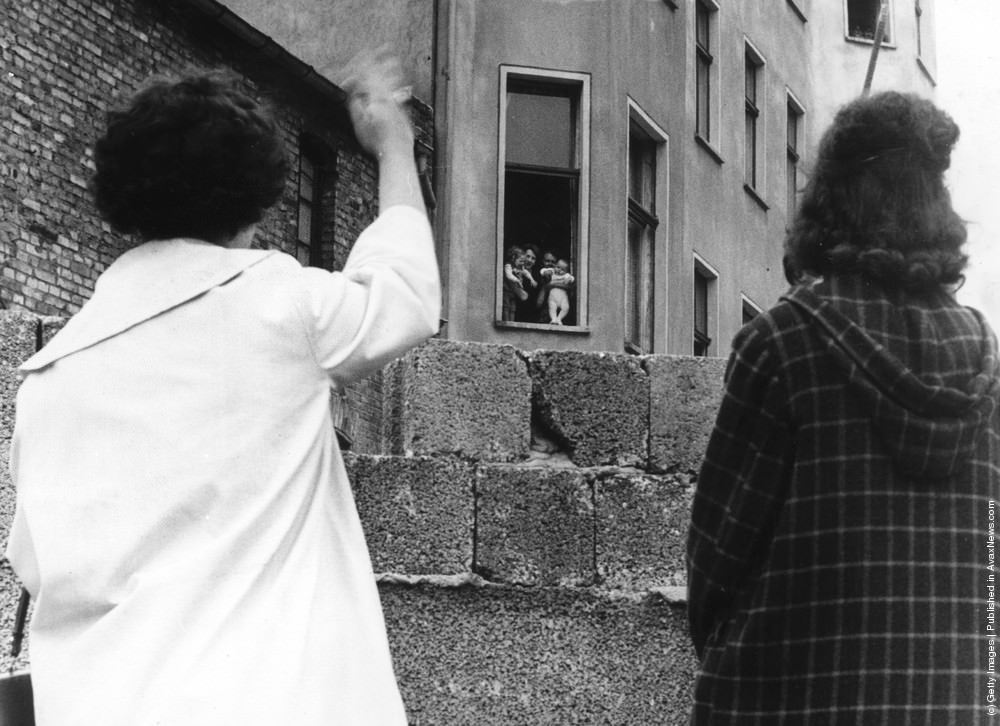
Arms raised above a rough line of stacked concrete blocks, two women stand in the street and wave toward a window where children and adults crowd together to look back. The barrier is low enough to see over, yet high enough to enforce the new reality of separation—an improvised wall cutting between neighbors, relatives, and daily routines. In the frame, ordinary apartment facades become the stage for a family reunion reduced to gestures.
Set in Berlin in 1961, the scene speaks to the suddenness with which the Berlin Wall—and the broader Cold War division of the city—reshaped private life. A few meters of masonry and rubble turn a familiar courtyard view into a border crossing, making the simplest act of visiting impossible. The mothers’ outstretched hands and the faces pressed to the open window underline what politics often obscures: the division of Berlin was also a division of households.
For readers tracing Berlin Wall history, this photograph offers a stark reminder that the earliest border fortifications were not yet the towering concrete slabs many later imagined, but a rapidly assembled obstacle that still carried enormous power. It captures the emotional geography of East Berlin and West Berlin at the moment lines hardened—when waving replaced embraces and conversation became silent pantomime. The image lingers as a quiet record of resilience, grief, and the thin space between loved ones when a city is split in two.