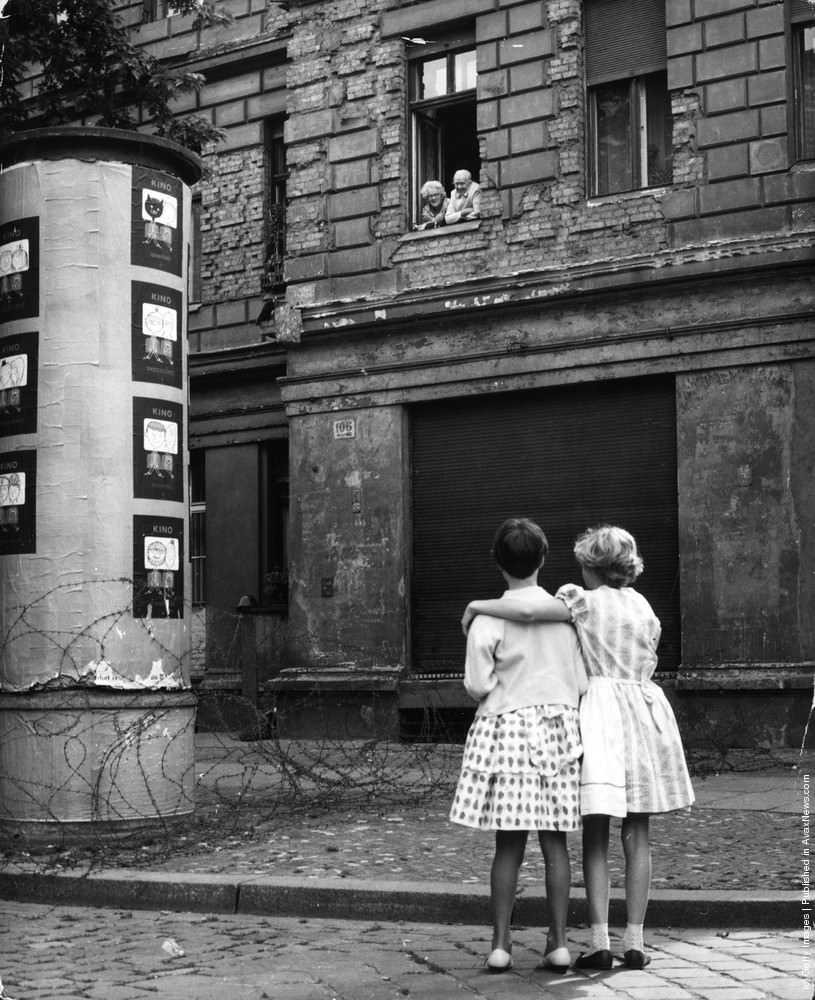
Barbed wire snakes across a quiet cobbled street while two little girls stand shoulder to shoulder, one arm draped around the other in a gesture that feels both protective and ordinary. Above them, an elderly couple leans from an open window of a worn apartment building, the crumbling façade and shuttered storefront below hinting at a city still marked by war and hardship. The girls look up as if conversation alone could bridge the sudden distance, their small figures dwarfed by masonry, pavement, and the new line drawn through everyday life.
Dated 14th August 1961, the scene reflects the tense first days of the Berlin Wall era, when improvised barricades split streets and families overnight between West Germany and the eastern zone. Here the border is not a distant checkpoint but a strand of wire at curbside, turning a front window into a meeting place and a public street into a no-go boundary. The poster column at left, layered with “KINO” notices, underscores how normal routines—films, errands, neighborhood chatter—continued in the shadow of an escalating Cold War divide.
What makes the photograph linger is its intimacy: grandparents craning forward to see and be seen, children rooted to the pavement, and a simple exchange rendered urgent by politics. For readers drawn to Cold War history, Berlin Wall stories, and the human cost of divided Germany, this image offers a stark reminder that separation was measured in meters as much as ideology. It belongs in any conversation about borders and civil conflict, showing how quickly a city can be partitioned and how stubbornly families try to stay connected across the cut.