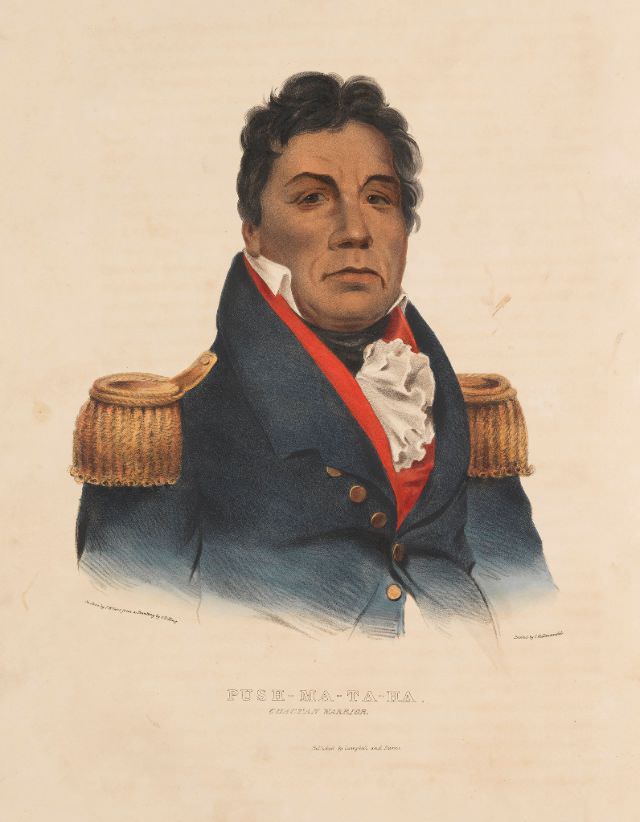
A steady, unsparing gaze meets the viewer in this formal portrait of Push-Ma-Ta-Ha, identified in the title as a Chactan (Choctaw) warrior. Rendered with the polish of early nineteenth-century printmaking, the figure is presented from the waist up against an uncluttered field, inviting attention to expression, posture, and dress rather than scenery. The overall effect is both intimate and ceremonial, the kind of image meant to carry authority beyond the page.
Deep blue fabric, bright red trim, and gold epaulettes signal a uniformed presence, while a white cravat softens the severity of the coat. The artist’s careful modeling of the face—subtle shadows, defined cheekbones, and slightly downturned mouth—suggests a man accustomed to negotiation as much as conflict. Beneath the portrait, the engraved caption “PUSH-MA-TA-HA” anchors the likeness, framing it as an official representation rather than a casual study.
As a piece of historical artwork, this portrait speaks to how Indigenous leaders were recorded, circulated, and interpreted through Euro-American artistic conventions. For readers searching for Push-Ma-Ta-Ha images, Choctaw history, or early American portrait prints, it offers a compelling visual starting point: dignified, restrained, and deliberate in its symbolism. The quiet background and front-facing composition keep the emphasis where it belongs—on a person presented as a public figure, with a story that extends far beyond the uniform.