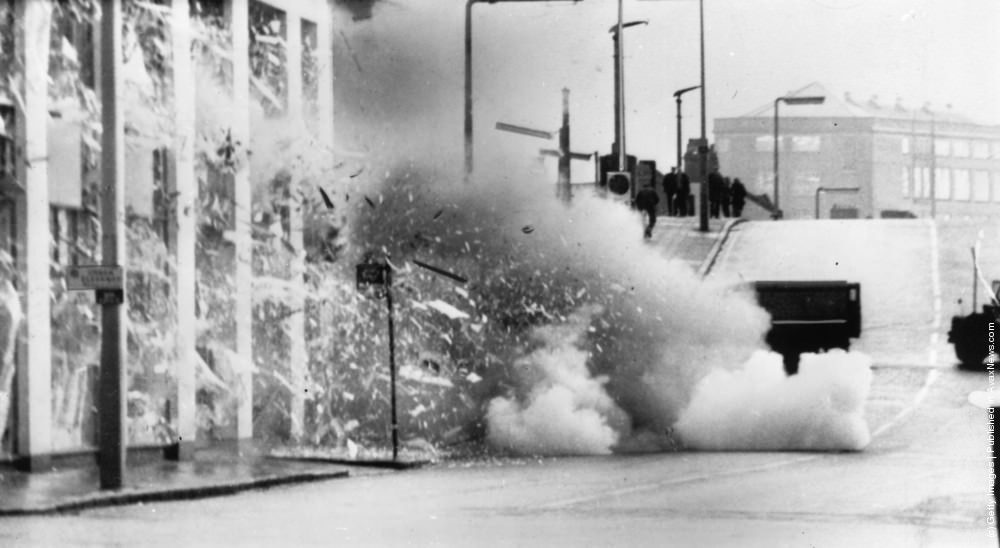
Shrapnel and dust erupt across a Belfast street as a parked car is torn apart in a controlled detonation carried out by troops, a split-second of violence frozen into grainy monochrome. The blast throws debris against the hard lines of nearby buildings, while a thick cloud rolls outward along the roadway, swallowing the curb and street furniture. In the background, the street’s everyday fixtures—lampposts, signs, and a distant vehicle—feel suddenly fragile against the force unfolding in the foreground.
What makes the scene so unsettling is its ordinariness: a familiar urban junction turned into a temporary battlefield, with a few figures kept at distance as the shockwave does its work. The title’s detail—17th November 1971—anchors the photograph firmly in the era of the Troubles, when bomb scares and emergency responses became part of daily life in Northern Ireland. Even without close-up faces, the image communicates the choreography of risk: containment, clearance, and the calculated decision to destroy one object to protect many lives.
For readers exploring civil wars and internal conflict, this photo offers more than spectacle; it illustrates how security measures reshape public space and civic rhythm. The controlled explosion speaks to a grim calculus of countermeasures, where streets can be sealed, vehicles treated as threats, and the normal flow of a city interrupted in an instant. As a historical document, it invites reflection on the tension between safety and fear—and on the lasting imprint such moments leave on communities trying to keep moving forward.