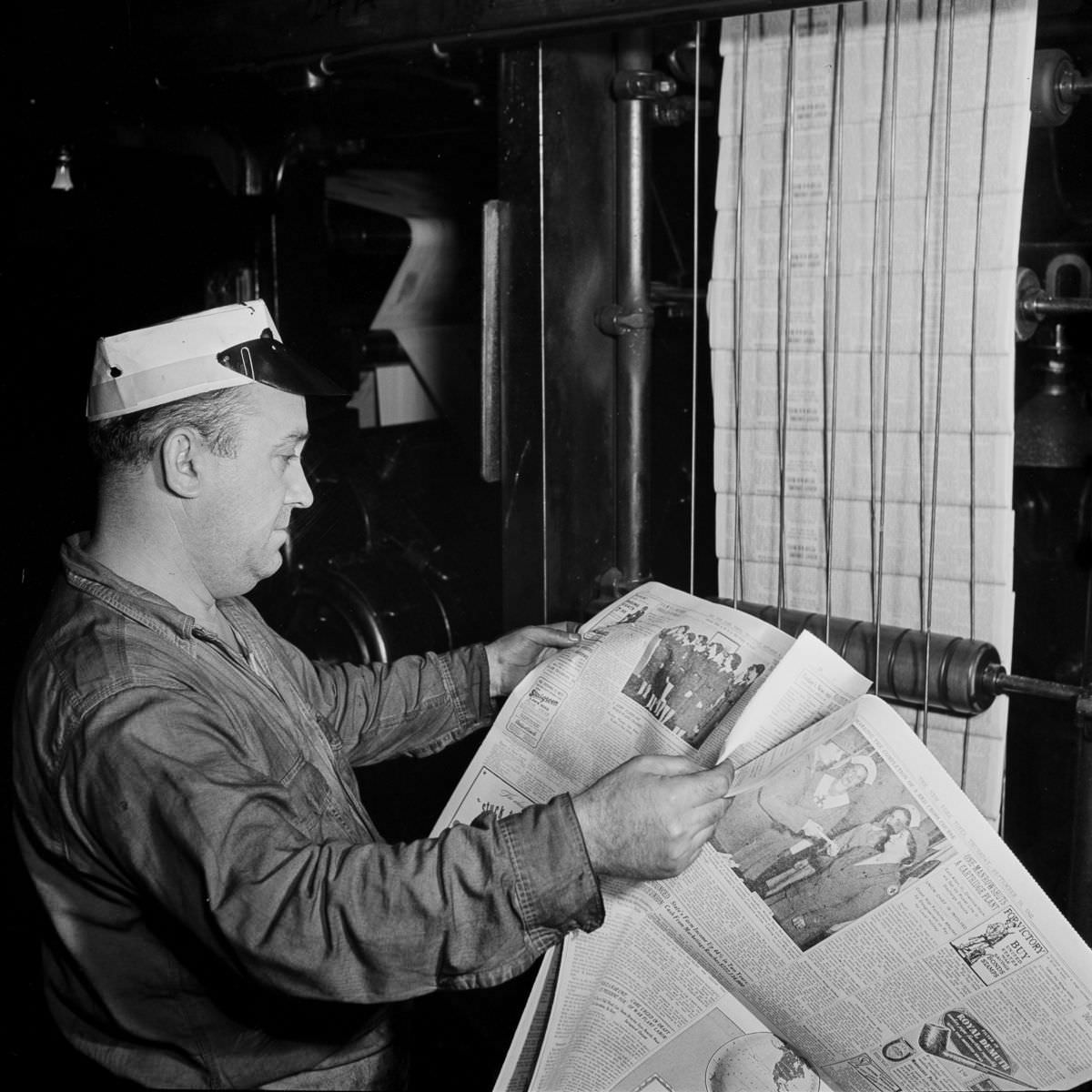
Under the harsh work lights of a pressroom, a pressman pauses the rhythm of production to study a freshly printed newspaper, holding it open with the practiced care of someone who knows a single flaw can multiply into thousands. The scene balances human attention against industrial power: a protective visor on his cap, ink-dark machinery surrounding him, and the first copies treated less like “news” and more like proof of performance.
To the right, long bands of paper stream through the press in tall, taut columns, suggesting the continuous-feed process that made mass circulation possible. Those towering sheets hint at the hidden choreography of rollers, tension, and timing—where alignment, pressure, and ink flow must meet perfectly to keep text crisp and photographs readable. Even without hearing the clatter, you can almost sense the urgency of a deadline and the disciplined calm required to keep the run clean.
Quality control in printing has always been a blend of craft and engineering, and this moment captures that intersection with uncommon clarity. He’s not just reading; he’s inspecting for defects—checking registration, density, smudges, and the small inconsistencies that reveal a machine drifting out of tune. For anyone interested in inventions and industrial history, the photograph offers an intimate look at how newspapers were made reliable at scale, one careful inspection before the presses truly roared.