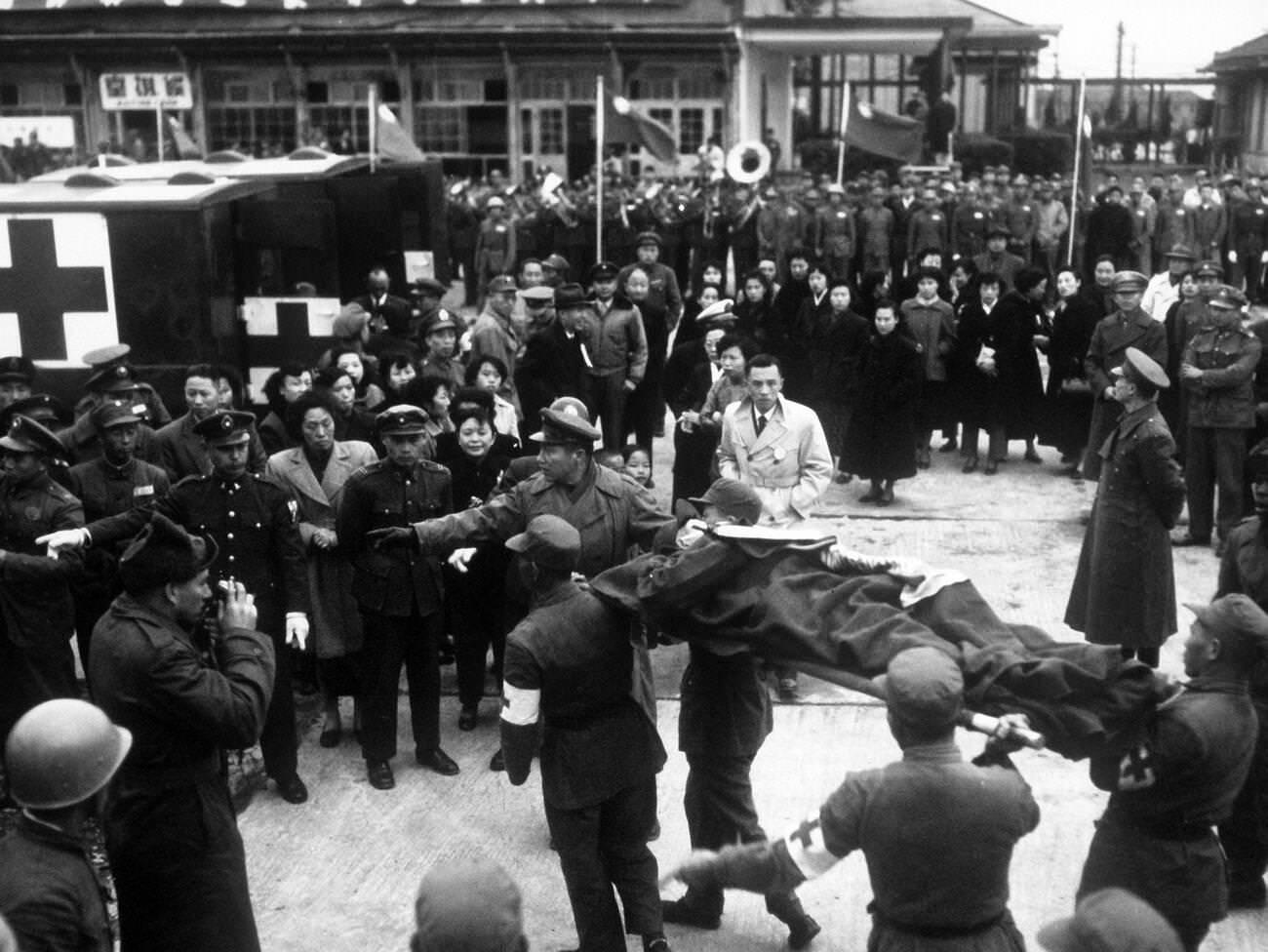
A crowded compound yard becomes a stage for transition as Chinese and North Korean communist prisoners of war are released during the Korean War era of the 1950s. Uniformed guards and officials press in on all sides, while civilians and onlookers cluster behind them, turning the moment into both a controlled procedure and a public spectacle. An ambulance marked with a large Red Cross sits nearby, hinting at the medical strain and uncertainty that often accompanied POW movements.
In the foreground, stretcher-bearers move quickly through the crush of bodies, suggesting that release was not always a simple walk to freedom but could involve injury, exhaustion, or illness. The faces in the crowd—some stern, some curious, some unreadable—underscore how prisoner exchanges and repatriation stirred fear, hope, and political tension in equal measure. Even without a precise place-name, the visible signage, flags, and dense security presence evoke the bureaucratic machinery that surrounded wartime detention.
Stories like this sit at the intersection of battlefield conflict and “civil wars” within societies—ideological divisions that outlast gunfire and follow people into camps, courtrooms, and negotiations. For readers searching Korean War history, POW compound life, and the humanitarian role of the Red Cross during prisoner releases, the photograph offers a stark reminder that diplomacy and logistics were inseparable from human consequences. It captures the uneasy threshold between captivity and return, where the end of confinement did not necessarily mean the end of hardship.