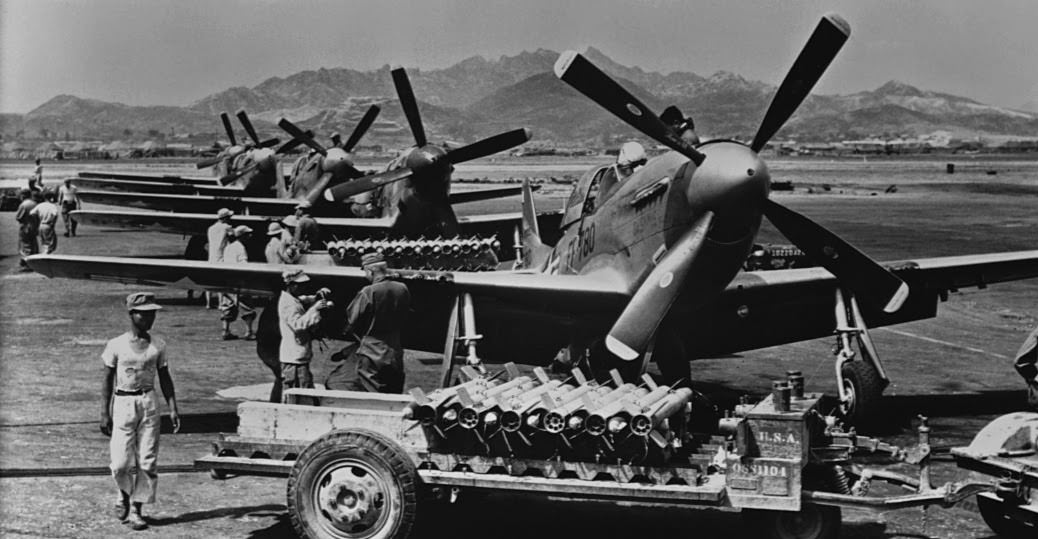
Propellers stand still for the moment as ground crews swarm a line of P-51 Mustangs on a busy airfield, the mountains beyond forming a hard horizon. In the foreground, a cart stacked with rockets and equipment underscores how much of aerial warfare depended on the labor and logistics on the tarmac. The aircraft sit nose-out and ready, their familiar long snouts and broad wings hinting at a design born in World War II yet pressed into new service.
At the start of the Korean War, the Mustang became the primary aircraft of United Nations forces not because it was the newest, but because it was available, rugged, and adaptable for close air support. The scene evokes the rhythm of rapid turnaround—arming, refueling, and inspection—where minutes mattered and missions followed one after another. Details like the clustered munitions and the crowded flight line emphasize the transition from airfield routine to combat urgency.
Jet fighters would soon redefine speed, altitude, and air-to-air combat, but this photograph preserves the twilight years of the great propeller era in military aviation. It’s a reminder that technological change rarely arrives all at once; older machines often carry the early burden of a new conflict while the next generation gathers pace. For readers interested in Korean War history, the P-51 Mustang, and the evolution from World War II aircraft to jets, the image offers an unvarnished look at how that pivot was lived on the ground.