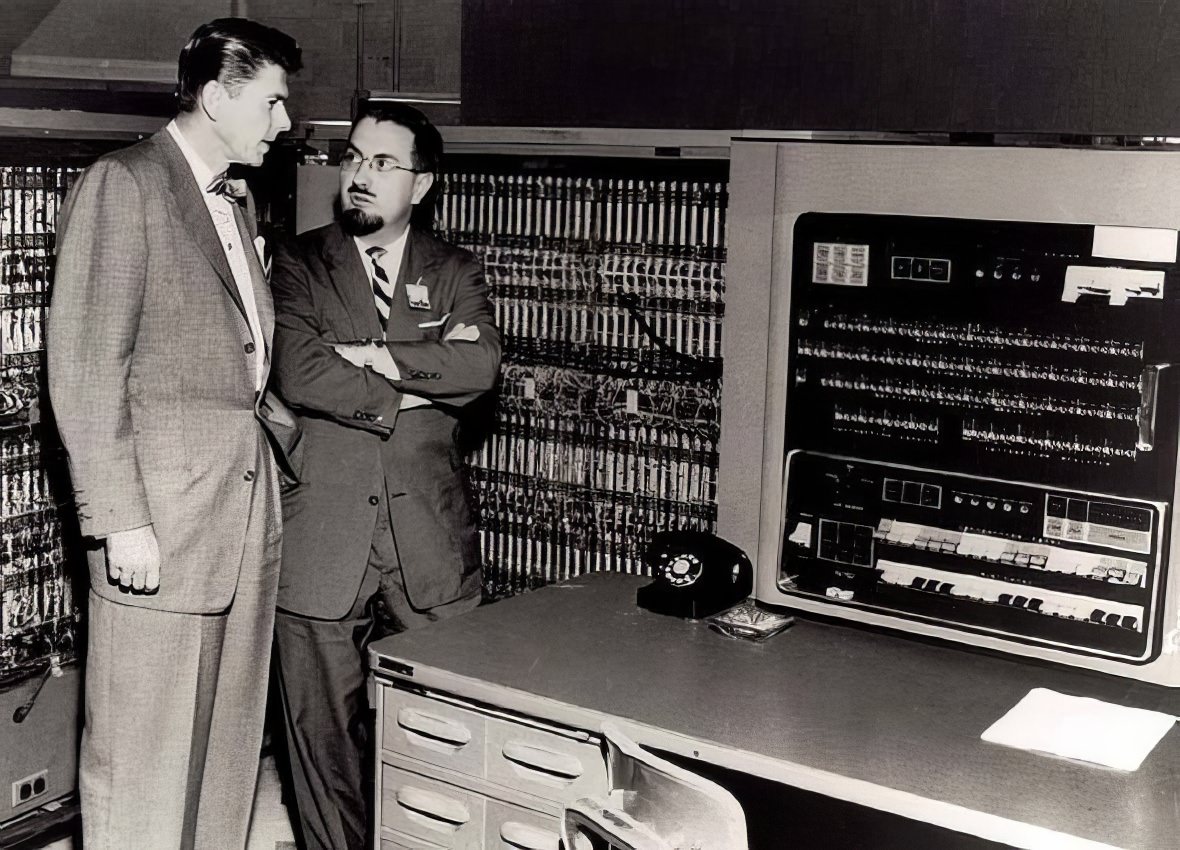
Behind the two suited figures, a wall of dense wiring and components hints at the scale of early electronic computing, when “computer” meant a room of hardware rather than something on a desk. At the right sits a large console with rows of indicators and switches, the kind of interface that demanded trained operators and a careful, methodical approach. The scene feels part laboratory, part control room—an atmosphere of experiment, calculation, and quiet pressure.
Introduced in 1952, the IBM 701 marked IBM’s first computer and signaled a decisive turn toward scientific work and research computing. Instead of office bookkeeping, machines like this were aimed at problems in engineering, physics, and other technical fields where speed and reliability mattered. In that context, the photo becomes more than a portrait of equipment; it’s a snapshot of institutions learning how to think with machines.
From these early installations grew a new culture of programming, one that pushed beyond low-level instructions toward languages that humans could use more naturally. The needs of 701-era scientific users helped set the stage for high-level tools such as FORTRAN, created to translate mathematical ideas into executable code. For readers exploring the history of inventions, the IBM 701 is a reminder that modern software and computing practices were forged in rooms like this—one panel light, one calculation, and one breakthrough at a time.