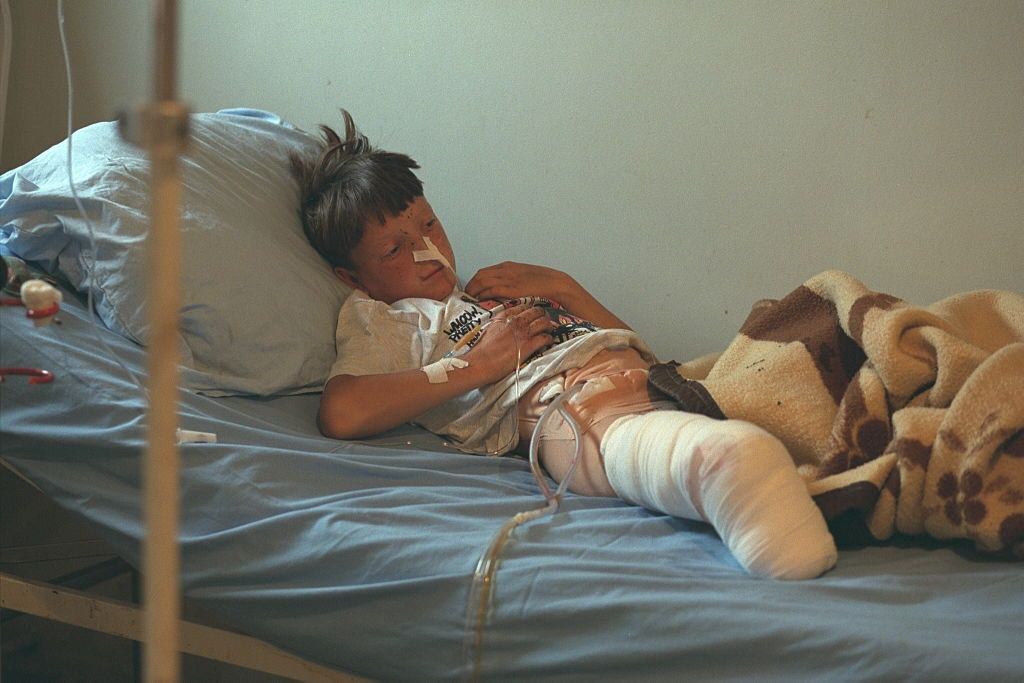
In a quiet ward at Prizren hospital, a young boy lies on a rumpled bed beneath pale walls, his face turned slightly toward the light. Tape crosses the bridge of his nose, an IV line runs to his arm, and exhaustion sits heavily in his expression. The thick bandage that wraps his lower leg draws the eye, a stark sign of an injury that has already rewritten the ordinary rhythms of childhood.
The title’s account—an amputation after stepping on a land mine—places this moment within the brutal logic of civil wars, where danger lingers long after the fighting moves on. Land-mines punish the most mundane acts: walking, playing, taking a familiar path. In the stillness of the room, the child’s small hands and the medical tubing suggest both fragility and the careful work of survival that follows such explosions.
Beyond the immediate medical crisis, the photograph speaks to the reveals of conflict that statistics often flatten: pain managed in hospital beds, families waiting in corridors, and the long, uneven road of rehabilitation. For readers searching for historical photos of land-mine victims, wartime hospitals, and the human cost of civil conflict in the Balkans, this image offers a direct, unsettling intimacy. It insists that “after” is not a clean ending, but a daily reality lived in bandages, blankets, and the slow return to strength.