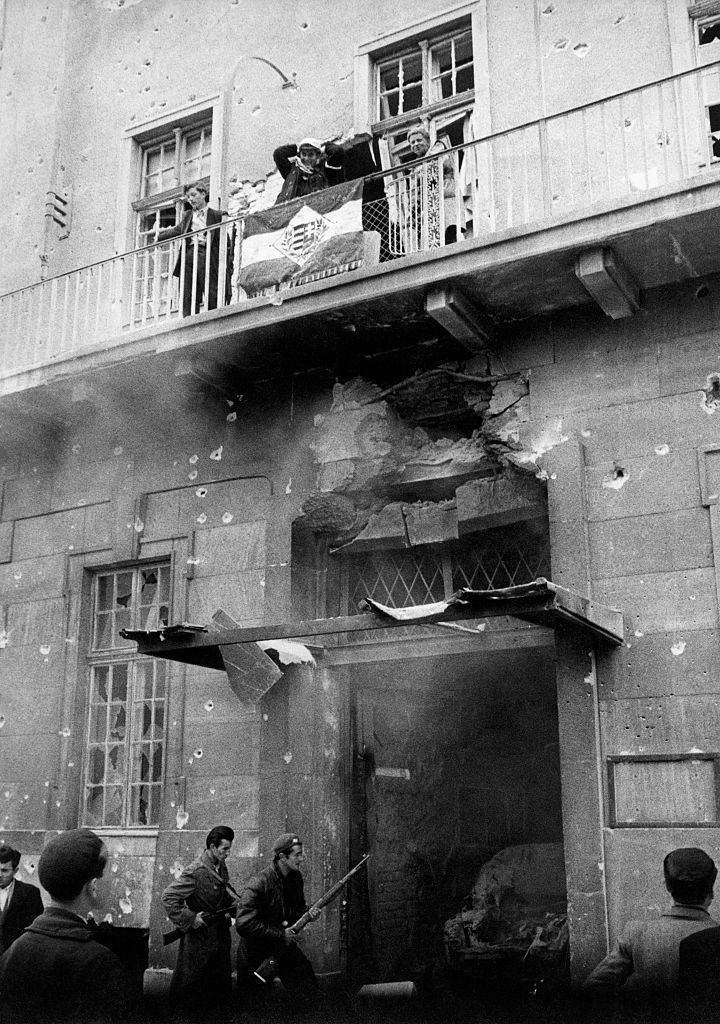
High above a scarred façade, a Hungarian national flag hangs from a balcony, its presence turning a battered building into a loud political statement. The walls are pocked with bullet holes and the windows are broken, details that speak to street fighting and the sudden violence of the 1956 Hungarian Revolution. Figures lean over the railing to look down at the scene below, as if taking stock of a moment that has already become history.
Below the balcony, armed men move near a damaged entrance canopy, the doorway framed by rubble and smoke-darkened masonry. The composition draws the eye from the shattered street level up to the flag, linking the cost of conflict with the symbolism of national identity. In Budapest, November 1956, such images captured the tense overlap of uprising, occupation, and the struggle for control in the heart of the city.
For readers searching the history of the Communist Party headquarters during the Hungarian uprising, this photograph offers more than a caption—it offers texture: the torn plaster, the splintered frames, the watchful posture of onlookers. It also echoes the broader theme of civil conflict, where buildings become battlegrounds and flags become messages. As a historical photo from Budapest 1956, it preserves an instant when power briefly shifted and the street announced it in cloth and concrete.