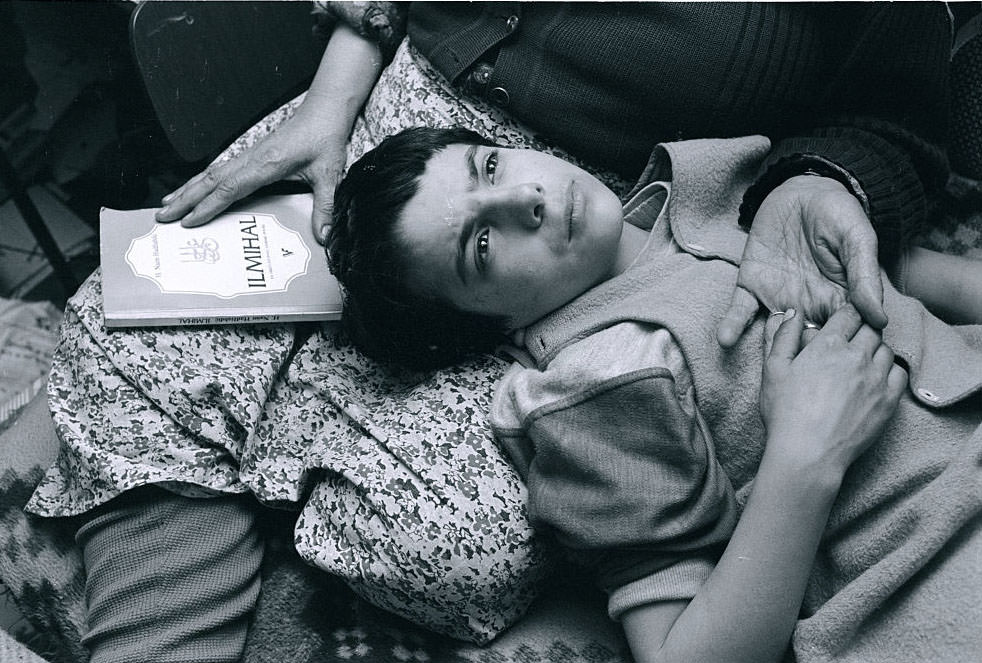
Quietly, a boy rests with his head in his grandmother’s lap, the posture as intimate as it is protective. The title identifies him as Mirza Mangajic, only ten years old, and the moment is framed not by ceremony but by closeness—hands folded, shoulders softened, eyes turned toward something beyond the room. In the grandmother’s steady presence, prayer becomes less a public act than a shared refuge.
Near their arms lies a small book labeled “ILMIHAL,” an everyday guide to faith that hints at the rhythms of religious life carried through ordinary objects. The patterned fabric beneath them and the tight cropping draw attention to texture, touch, and breath, as if the photographer wanted us to feel the quiet weight of the room. Nothing here is staged for grandeur; the power comes from the details that signal home, family, and continuity.
Read alongside the post’s theme of civil wars, the scene takes on added gravity, suggesting how devotion and caregiving persist even when the wider world turns unstable. Rather than offering a battlefield narrative, the photograph points to the domestic front—where children and elders hold onto tradition, comfort, and routine amid uncertainty. For readers seeking historical photos of Muslim prayer, family bonds, and wartime civilian life, this image offers a poignant reminder that endurance often looks like tenderness.