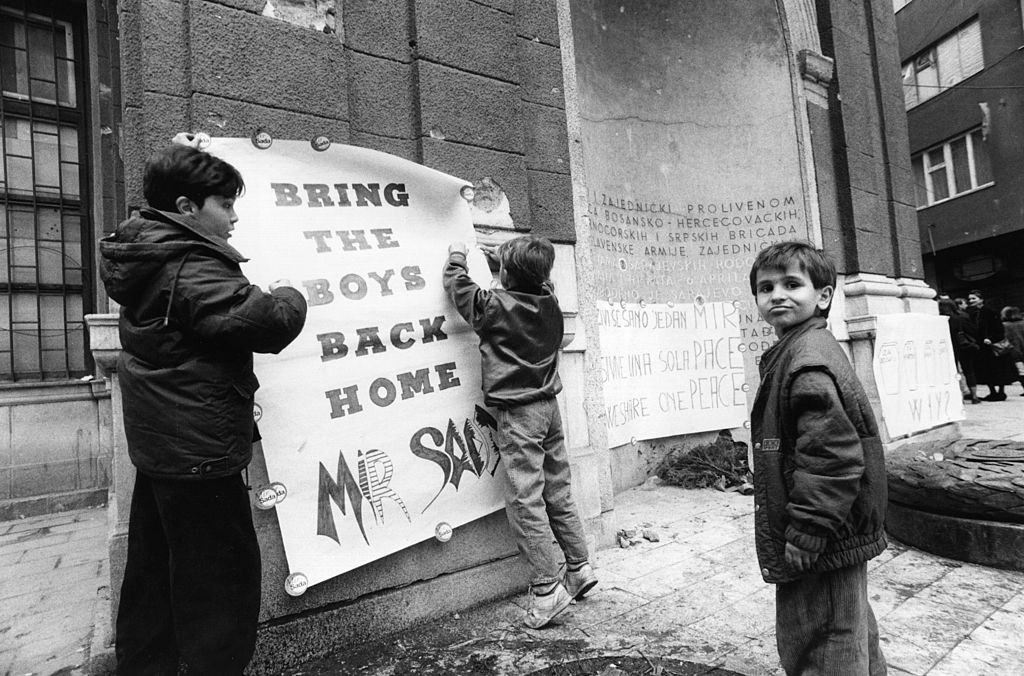
Against the rough stone of a Sarajevo street in 1994, three boys work with quick, careful hands to fix a poster in place—its message, “Bring the boys back home,” printed in large block letters that refuse to be ignored. One child presses the paper flat while another reaches up to secure it, and a third pauses to look toward the camera, caught between curiosity and the heavy seriousness of the moment. Their winter jackets and the gritty pavement ground the scene in everyday life, even as the words on the wall speak to a city living through civil war.
The setting tells its own story: scarred masonry, handwritten notices nearby, and a corner where public space becomes a canvas for pleading, protest, and survival. Peace demonstrations often rely on grand crowds and loud slogans, yet here the appeal is intimate—children taking part in the simplest form of civic action, pasting a demand for return and safety where neighbors will pass. “Bring the boys back home” reads as both a political statement and a family prayer, echoing the anxieties of separation, conscription, and loss that define wartime Sarajevo.
What lingers is the tension between youth and conflict, between play-age faces and the responsibilities forced on them by circumstances. Photographs like this offer a sharp entry point into the history of Sarajevo during the 1990s, revealing how ordinary people—especially the youngest—became participants in the struggle for peace. For readers exploring civil wars, anti-war protest, and civilian life under siege, this image preserves a small act of hope pinned to a wall, insisting that home should be possible again.