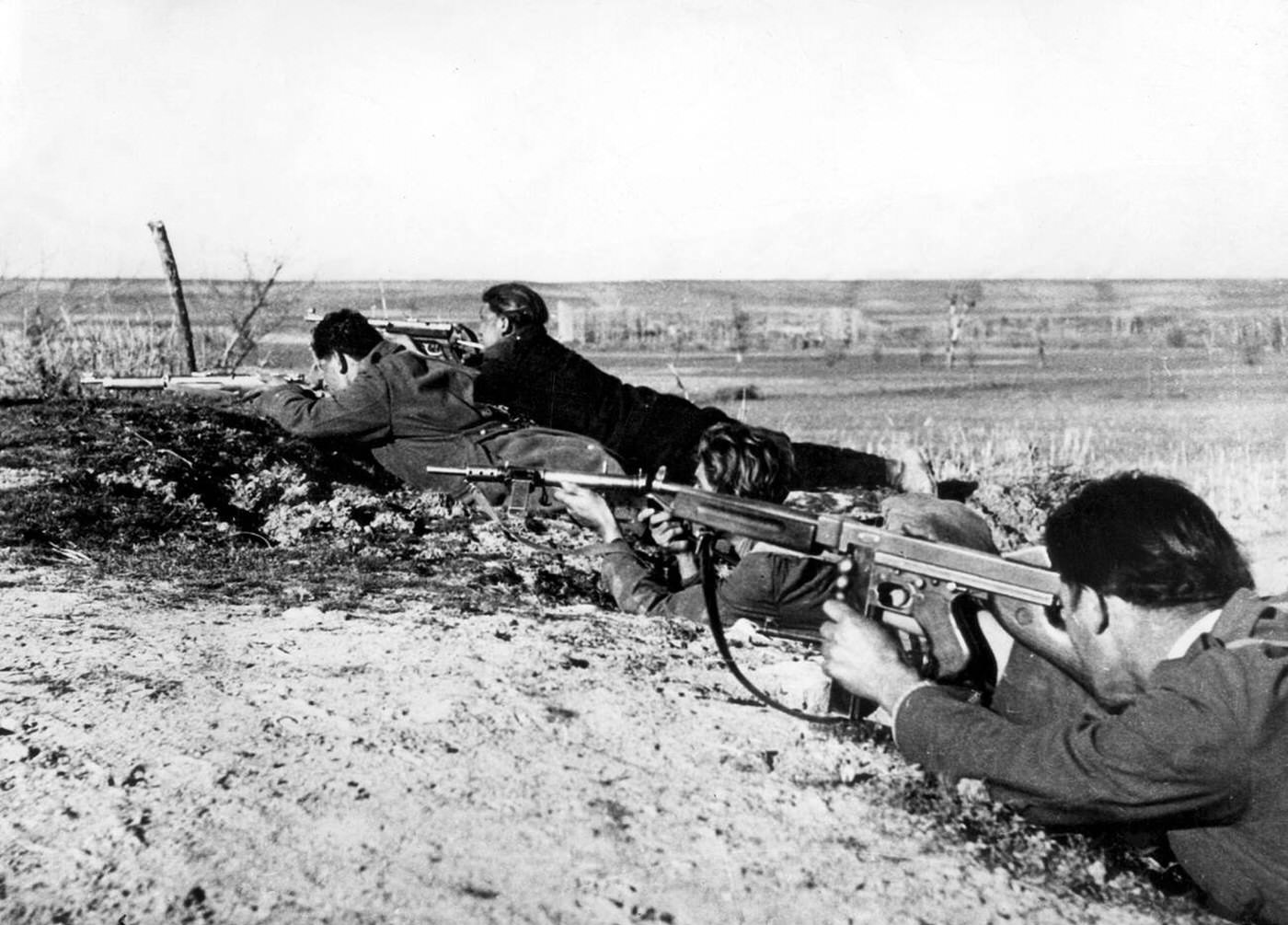
Pressed low into a shallow berm, three armed men aim their rifles across open country, using the thin rise of earth as their only protection. The scene is stark and spare: bare ground in the foreground, a wide horizon beyond, and the tense stillness of bodies aligned toward an unseen threat. Details like the slung strap, the careful sighting posture, and the improvised cover hint at fighting where terrain mattered as much as numbers.
In the 1940s Greek Civil War, battles often unfolded far from grand parade grounds, in fields, ridgelines, and rural approaches where visibility could mean survival. Photographs like this bring the conflict down to human scale, reminding us that “civil wars” are experienced in minutes and meters—waiting, watching, and committing to a line of fire. Without relying on captions or identified units, the image speaks through its geography and the practical, workmanlike way these fighters hold their positions.
For readers exploring Greek history and the wider postwar turmoil of Europe, this historical photo offers a vivid entry point into the era’s uncertainty and division. It pairs well with discussions of guerrilla tactics, the militarization of everyday landscapes, and the way the 1940s reshaped communities long after the shooting stopped. As part of a WordPress archive on the Greek civil war, it serves both as visual evidence and as a prompt to ask what lies beyond the frame.