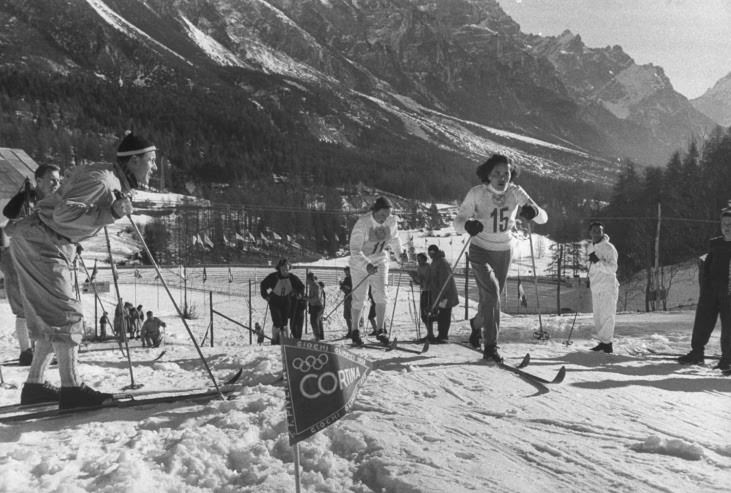
High in the Italian Alps at Cortina in 1956, two Soviet cross-country skiers—Lyubov Kozyreva taking gold and Radya Yeroshina earning silver—push across a sunlit, churned-up track where every pole plant bites into the snow. Bib numbers stand out against pale racing tops, and the athletes’ forward-leaning posture conveys the relentless pace of Nordic skiing, a discipline won as much by endurance and technique as by speed.
Behind the racers, a small cluster of officials and spectators lines the course, their dark coats and stillness contrasting with the rhythmic motion of skis and poles. A course marker bearing “Cortina” and the Olympic rings anchors the scene in the Winter Games atmosphere, while jagged peaks and scattered trees frame the competition like a stage set—beautiful, cold, and unforgiving.
Sports history often lives in grand ceremonies, yet moments like this reveal what medals really mean: effort etched into a single stretch of snow, watched by a handful of witnesses and the mountains themselves. For readers searching Olympic history, Soviet winter sports, or women’s cross-country skiing, this photograph offers a crisp glimpse of 1956 competition—where Kozyreva and Yeroshina’s finish-line honors were earned stride by stride on an Alpine course.